Showing posts with label Politics. Show all posts

Wednesday, January 17, 2007

A Few Antitheses on Same Sex Relationships

Having enjoyed Kim Fabricius' continuing propositions series at Faith and Theology, I was excited to see him recently address the issue of homosexuality in the Church. Same-sex relationships, of course, remain one of the most divisive issues in Christendom (as demonstrated by the gaining fissures within Anglican Communion), producing far more heat than light on all sides of the debate. Given such an atmosphere of off-putting rhetoric, any salient theological insight should be received with gratitude, and I'm thankful for Kim's efforts to crystallize the deeper issues which concern both the ancient voices and those of contemporary dissent.

Antithesis #1 Kim addresses the nature/nurture issue in proposition 2, and provides what I think is the bedrock for an inclusivist case - namely, that homosexuality is about identity, not a set of practices or learned behavior. It's at this point where the discussion can get unnecessarily bogged down in scientific analysis about genetic predisposition - but one has to ask whether the "natural" can provide much help for Christians who are discussing the normativity of certain behaviors. Demonstrating that a behavior is "natural" requires further distinction (both in contemporary discussion and the use of Biblical arguments from "nature"), since Christian ontology is a complex of two elements - namely, the divinely stamped image of God and the fall of man into sin. All sorts of activities can also be shown with confidence to be genetically predisposed, yet Christians passionately affirm them as defective of the image God, not representative of it. Describing homosexuality as a congenital disposition, then, merely restates the debate, not advances it.

Antithesis #2 The use of the Bible in resolving these sorts of questions has been an axiomatic problem for theologians, for which homosexuality is a banner example. But Kim doesn't resort to the common tactics of simply dismissing the Bible on the grounds of interpretive impossibility - he actually acknowledges (in proposition 3) that the Bible clearly prohibits homosexuality. His real objection in appealing to Biblical authority is that it's not exactly clear whether the phenomena the Bible condemns is actually the same phenomena as is currently conceived. But this tabling of the Scriptures on the topic may be premature, on two fronts. The first is what seems to me to be an undervaluing of the sophistication of Greek sexuality. Kim's point about the difference between ancient and modern conceptions of same-sex love seems to assume the reduction of homosexual behavior to cult prostitution or episodic erotic encounters. But a few biblical scholars (and not a few classicists) acknowledge the warm, loving, and committed variety of ancient same-sex relationships. Kim is right to assume that the issue of identity bound up with homosexuality is much more pointed today than in ancient times, where activity and identity were conflated - but its important to note that these notions weren't pit against one another. Identifying oneself as "homosexual" would have certainly been foreign to Greek ears - but the "natural" attachment to the same sex celebrated by the ancients doesn't seem too far from our understanding of homosexuality (and much closer to Paul's than some are willing to admit).

Secondly, though, the Bible's teaching on sexuality goes far beyond apophatic pronouncements and prohibitions. The positive teaching of Scripture gives a theologically nuanced affirmation of heterosexuality, out of which these prohibitions grow. Jesus' teaching about man as male and female, mysteriously fused together in marriage is God's institution of a normative social convention. The imagery projected by this union is explained by Paul as the mystery of Christ's love for the Church. Far from being one metaphor one could choose among many, this is a "mystery" - the same word used in Ephesians to describe the amazing union of Jew with Gentile in the dissolution of national ethnic barriers in the Church. The Biblical language of idolatry as a diversion from this monogamous heterosexual union isn't incidental. Both adultery (Ezk. 16) and homosexuality (Ro. 1) illustrate idolatry and corrupt this intended projection. Exactly how all of this works, as Paul says in Eph. 5:32, is a mystery. But what remains clear is that he is "speaking with reference to Christ and the Church". If these connections to the imago Dei were ad hoc constructions of the later church, I might agree with Kim about the exegetical difficulty of Gen. 1:26-28 as a proof-text - but as it is, the Biblical writers themselves have seen the sexual prohibitions as having grown out of God's ideal design. It's a fundamental misunderstanding of Romans 1 to see the listing of homosexuality as just another Jewish polemic against Gentiles, or as just another sin which emerges from idolatry. Same sex relationships are given a par excellence place in his argument against idolatry because it pictures the replacement of the Other - God - for that which is the same - created things (a very Barthian critique).

Antithesis #3 Kim appeals to a trajectory principle to marshal Biblical warrant for the inclusion of practicing homosexuals in the Church - an approach with as conservative prestige as to attI. Howard Marshall and William Webb. But this is a controversial concept, to be sure. Kevin Vanhoozer has aptly warned, "One problem with this approach is that the interpreter has to assume that he or she is standing at the end of the trajectory, or at least further along (or better at plotting line slope intercept formulas!) than some of the biblical authors in order to see where it leads." Again, this is a very Barthian concern, in that it puts the interpreter in His place, in the driver's seat of the redemptive-historical train. At best elusive, and at worst prejudicial, the trajectory approach toward inclusion is capable of casting nets wider than anyone might wish, depending on the judgment of the one who happens to be "plotting the slope".

Antithesis #4 I hesitate to add to Kim's eloquent call to live in the truth and witness to Christ in proposition 12. It is a beautifully stated fact of Christ existence, namely our reliance on the Spirit for words and actions tempered with love, joy, peace, patience, kindness, goodness, faithfulness, gentleness and self-control. Yet, in the context of the Churchly warring over this issue, it should probably be said that no one has the corner on this particular market. Not so much an antithesis as a clarification, it should be said that for those who see homosexuality as fundamentally unbiblical, there is a vast difference between our view of the morality of homosexuality and our view of the Church's moral obligations to homosexuals. That is to say that the warmth of contact and fellowship of Spirit-filled Christians with lesbian and gay people can be a reality for those who, despite their views on homosexuality as sinful, take very seriously their ethical responsibilities toward these commonly mistreated individuals. If there is any hint of antithesis here, it's at the notion that inclusion be defined in terms of a coupling of divine grace and ecclesial ontology with the moral acceptance of homosexuality - which is an all too infrequently mentioned bully tactic.

Remarkably, though, Kim Fabricius has managed to contribute to the Church's wrestling with these explosive issues without resorting to anything like the tactics he decries, delivering with the same characteristic grace and insight as we have come to expect from him.

Thursday, February 23, 2006

Jesus Is Lord

I was recently incited to worship by a paper given by Marianne Meye Thompson. It was about the Lordship of Jesus, which is something I've been thinking about lately, and since I'm terribly busy this week I thought I'd reproduce part of it here for your reading enjoyment, hoping it will have the same effect on you.

By the way, in reading the following don't get too nonplussed by her comments about meeting those of "other religions" with kindness and acceptance. Remember she says "as much as one can", and realize that the rest of her article makes it pretty clear that she believes salvation can be found nowhere else but in Christ alone. The balance of honoring what's true and correcting all that errs in the worldview of others follows Paul's own pattern in addressing the Gentiles (Acts 17:22-34).


Our context is no more pluralistic than was the context of Paul or of any of the apostles who lived, worked, and taught in the Roman empire of the first century of this era. Although people are fond of saying so, we do not live in unprecedented times. The world of the early church knew of the claims that there were indeed “many lords and many gods.” There were claims for the gods of nationalism and power, such as the Ceasars and Rome; for the various gods of foreign and mystery cults, such as Isis and Osiris; local and civic deities, such as Athena, Artemis, and Apollo; the gods of chance and fate, such as fortune, fate, and luck; and the generic life force of the universe. Precisely in the context of such claims, Paul affirmed that there is “one God, the Father, and one Lord, Jesus Christ.” Our world, too, knows of “many lords and many gods” – and many of them take the same form as they did in Paul’s own day – nationalism, foreign deities, fate and fortune, and the pantheistic belief that all is God. In the ancient world, Christianity provided an alternative to the shapeless confusion of antiquity; in the modern world, it can provide the same alternative, but only if it articulates the gospel clearly.

In such a world, it is urgent that the Church have the courage to speak its belief in the one Lord, for this is the content of the Gospel. In making this proclamation, it must be clear that it does not seek to add another deity to the pluralistic mix, but that it intends to bear witness to the Lord who is “above every name,” for he is the one whom God has “set above all rule and authority, all power and dominion.” In other words, the foundation of the church’s confession and proclamation who Jesus is, through God’s mercy and grace, for all the world and also for us. The confession that Jesus is “my personal Lord” is not the same as the confession “he is Lord.” And unless we truly believe that he is Lord, we ought not to make the confession he is “my Lord,” because to do so is tantamount to idolatry, honoring one lord among many lords.

As one author put it, “To assert today that the one Creator God has revealed himself fully and finally in Jesus Christ is to risk criticism on the grounds of arrogance or intolerance. The mission of the church, however, does not commit Christians to the proposition that there is no truth to be found in other religions. All philosophies or religions which have some ‘fit’ with the created world will thereby reflect in some ways the truth of God. [This] does not, however, imply that they are therefore, as they stand, doorways into the new creation. That place … is Christ’s alone” (N. T. Wright, Colossians and Philemon [Leicester: Inter-Varsity; Grand Rapids: Eerdmans, 1986], p 79).

If the church compromises its witness to the Lordship of Christ, then it has ceased to be the church of Jesus Christ. But in proclaiming and living this news as good news, we must be certain that our mode of confession matches the trajectory of the self-giving and self-emptying of the crucified one who loved us and gave himself for us. So question 52 of the Study Catechism asks, “How should I treat non-Christians and people of other religions?” Answer: As much as I can, I should meet friendship with friendship, hostility with kindness, generosity with gratitude, persecution with forbearance, truth with agreement, and error with truth. I should express my faith with humility and devotion as the occasion requires, whether silently or openly, boldly or meekly, by word or by deed. I should avoid compromising the truth on the one hand and being narrow-minded on the other. In short, I should always welcome and accept these others in a way that honors and reflects the Lord’s welcome and acceptance of me.”

If this is what the catechism asks of us in relationship to people of other religions, how much more should we deal with friendship, kindness, generosity, and forbearance with our sisters and brothers in Christ. In other words, the virtue we must seek to cultivate is not the American virtue of tolerance, but the biblical virtue of humility. Humility is not the same as tolerance, for humility recognizes that a word of judgment may always be addressed to us, and that there are logs in our own eyes which we need to remove. Humility is the stance that we, as those who are united in baptism to the death and resurrection of our Lord, must seek. We have a long ways to go before we show the kind of compassionate and courageous love which Jesus demonstrated to the tax collectors and sinners as he welcomed them to his table. We forget the scandalous character of his act, as we forget the shameful character of his death on the cross, which he endured for us while we were yet sinners . There will be a profound irony and, indeed, shame if those of us who insist most vociferously that “Jesus is Lord” are also known to be characterized by a lack of humility and love.

But as the catechism states we must also “meet error with truth.” There is no formula — nor has there ever been — a formula for how one measures and mixes truth and forbearance. Paul’s unflagging commitment and unfailing compassion can remind us that we can never compromise on our zeal for truth —or for forbearance. This is neither an easy road to walk nor an easy witness to bear. But let us also be reminded that where the church fails to hold fast to its commitment to Christ as Lord, and therefore to hold and speak this truth in the humility of Christ himself, the loss is not only ours, or the church’s, but also the world’s.

Wednesday, September 21, 2005

Stereoscopic Social Justice


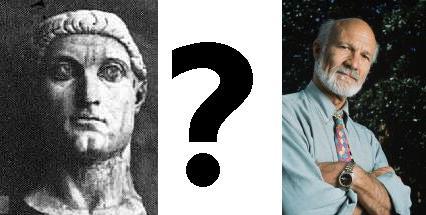
I recently enjoyed reading Stephen Bush’s proposal for a middle-way “between Hauerwas and Constantine” (what he calls “a stereoscopic political theology”, as opposed to the “monosocopic” vision of those who see the church as the only legitimate political enterprise). Bush’s paper did a wonderful job of giving expression to the gastronomic tension which has characterized my contact with the “radical orthodoxy” of neo-traditionalism. The initial enchantment that comes from beholding the magnificent, towering ideology of Yoder’s ecclesiology soon plummets into saddened disbelief at the church that actually exists in our world today. When one’s eyes are open to the extent to which powers and principalities dominate the institutional realities where we live and minister, a conscientious first response is to form apocalyptic communities in the desert rather than face the hopeless task of reform in the church, much less the state. But Bush perceptively points out that while we bear the ethical responsibility of picturing the coming kingdom, our hope is that Jesus will not only make things right in the world, but that he will transform the body of Christ to resemble its ideologue: “to be theologically accurate, we must start by noting that it is the eschaton that is the true political alternative to both nation-state and the church (emphasis mine).” That is to say the church doesn’t merely triumphantly mirror kingdom life in hopes of drawing sinners into our communities, we draw sinners into a shared groaning for God to bring the kingdom in which he establishes justice. Therefore our confession and transparent neediness forms the platform upon which meaningful political cooperation can occur without idolatrous culpability. With this tension between church and state eased (though not finally resolved), it is easier to see how one can act on the inevitable urge to support, pursue and endorse those public policies that manifest neighbor love while not engaging in idolatrous collaboration with alternative kingdoms; and that is a freeing consideration. Christian virtue is free to act outside of the singular desire to simply display Christian virtue – acts of justice, kindness and sacrificial charity can be conducted without fear of distorting ideological baggage being inadvertently attached to such actions. In other words, the desire to communicate Christian ideology doesn’t trump the actual enactment of that ideology for the benefit of those served by it. As far as I understand, Bush isn’t endorsing the Constantinian compromise to effect structural change under detached moral principles for the benefit of all – rather, he’s pointing out the moral responsibility of those who have the power to act justly to act justly even if their actions may not be construed as acts of biblical faithfulness. This, of course, doesn’t collapse the distinctions between the moral pursuits of the church versus those of the state. The church must take special care to not compromise its message in order “to help people”, not least by refusing to divorce its pursuit of particular policies from the storied ethics that drive our concern; but on the other hand we should take seriously the moral responsibility of being de-facto constituents of a participatory (albeit pagan) system.

Tuesday, September 13, 2005

Remembering 9/11 - Part Three

The Gospel comforts America’s fear with the hope of Jesus’ victory over death. It confronts America’s no-strings-attached faith in god (little ‘g’) by calling her to a radical faith in the Living God combined with true repentance. But beyond fear and faith, America’s response to Sept. 11th raised some disconcerting questions about America’s future. There was a plainly stated sense of uncertainty about what life in this country would be like after this event. Would America be the new Palestine, where we’d hear helicopters constantly circling in the skies and gunfire outside our houses? Would our cities be full of barricaded roads and our urban streets bear the mark of persistent military presence? If nothing else, one tangible difference that I’ve experienced after Sept. 11th is the guarantee that I will be frisked every time I go to the airport. But outside of the occasional involuntary massage, the problems for America seemed much bigger. The world, especially the western world, instantly became a more dangerous place than anyone living here could have ever projected.

Andrew Sullivan, in his TIME magazine article on the one-year anniversary of the attacks, “Most of us know that there is no moving on from Sept. 11. It wasn't a random tragedy for which grief is a slow-acting salve. It was a massacre—a premeditated murder of civilians by men possessed by a theocratic ideology. It was an invasion—the violation of sovereign American soil, the erasure of a visible monument to American success and energy and civilization. It was a crime—the filling of the air of a great and free city with the irradiated dust of innocent human lives. It was a statement—that radical Islam intends to attack and destroy the very principles of the Enlightenment that underpin the American experiment—freedom of religion, of conscience, toleration and secularism.”

Later on in the same article he observed: “[Sept. 11th] showed us that we stand deeply vulnerable to a destructive force in some ways more dangerous than even the last two totalitarian powers Americans were called on to defeat. This enemy refuses to fight with honor; it hides and disappears and re-emerges whenever its purposes are served; it may soon have access to weapons that Hitler and Stalin only dreamed of. But it cannot be defeated the way Nazi Germany and Communist Russia were defeated because it is more like a virus than a host, infecting and capturing nation-states, like Afghanistan, and then moving on to others. So we will have to act to pre-empt it this time, in Iraq and elsewhere, or it will be too late to resist it at all. For Sept. 11 showed that, for the first time in history, the American homeland is actually vulnerable to a deadly foreign enemy.”

These comments aren’t new or revolutionary – they reflect the same oft repeated sentiment offered by the President immediately following the attacks, and that of most Americans: 9/11 has changed the world; nothing will ever be the same again.

As followers of Jesus, what should we make of that sentiment? Has this admittedly horrifying national tragedy really changed the world? In his Olivet discourse Jesus declared, “You will be hearing of wars and rumors of wars. See that you are not frightened, for those things must take place, but that is not yet the end. For nation will rise against nation, and kingdom against kingdom, and in various places there will be famines and earthquakes But all these things are merely the beginning of birth pangs.” These words weren’t meant to be an eschatological escape hatch by which we avoid very real issues for which we are called to be responsible salt and light in favor of more "heavenly" concerns – but the point is clear. We’ve always had war. Humanity has continually witnessed violent rebellion against sovereign nations (that’s how America was born, remember?) – violence, pain, suffering and evil are as old as sin. But these words, "9/11 has changed the world" are not only dissonant with Jesus’ own realism – they also ring hollow to those countries who’ve suffered injustice on an even larger scale before 9/11, and continue to suffer today. American culture tends to insulate us from the concerns of other nations by their sheer irrelevance to our own well-being. The far-removed turmoil of Rwanda, Darfur, or Nepal are so outside the pale of national self-interest as to not qualify as “world changing” horrors for the people of the United States. It seems as though September 11th, 2001 didn’t really change the world – it continues to be mostly devoid of incarnational, self-deprecating neighbor-love.

But there was a day in human history that really did change the world, because it put an end to the politics of death. One day in 30 AD Jesus the Nazarene (a man attested to us by God, who was delivered over by the predetermined plan and foreknowledge of God) we Americans nailed to a cross by our self-involved godlessness and sin. But God raised Him up again, putting an end to the agony of death, since it was impossible for Him to be held in its power. Therefore let Americans know for certain that God has made Him both Lord and Christ—this Jesus whom, by our sin, we crucified. And if Americans are pierced to the heart, let each one of us repent, and be baptized in the name of Jesus Christ for the forgiveness of our sins; and we will receive the gift of the Holy Spirit. For the promise is for all Americans, and their children and for all who are far off, as many as the Lord our God will call to Himself.

The future of America may be uncertain – but the future of those who trust Christ for the forgiveness of sins is not. Their future is a kingdom in which death has been put to death, fear has been exiled, swords have been made plowshares, and all nations and ethnicities have been reconciled into one New Humanity. In this kingdom the law is love, the economy is grace, and the King is God with us. It is a kingdom to come, yet has broken in on our world through the resurrection of Jesus and the Church which His new life empowers through the Spirit.

Rooted in the Spirit’s filling power Paul can raise a defiant voice to the powers that continue to rule below: “Who will separate us from the love of Christ? Will tribulation, or distress, or persecution, or famine, or nakedness, or peril, or sword? Just as it is written, "FOR YOUR SAKE WE ARE BEING PUT TO DEATH ALL DAY LONG; WE WERE CONSIDERED AS SHEEP TO BE SLAUGHTERED." But in all these things we overwhelmingly conquer through Him who loved us. For I am convinced that neither death, nor life, nor angels, nor principalities, nor things present, nor things to come, nor powers, nor height, nor depth, nor any other created thing, will be able to separate us from the love of God, which is in Christ Jesus our Lord.”

Monday, September 12, 2005

Remembering 9/11 - Part Two

America is probably one of the most religious countries on earth. Regardless of whether Enlightenment deism or Christian theism lies at its root, religion has undoubtedly played a huge part in the founding of it; it’s vocabulary is strewn across the pages of subsequent American history. But maybe more than ever in recent history, Sept. 11th put God-talk off the charts. Everyone was asking God to bless America, questioning how God could let this happen to America, or promising God's wrath to those who would dare tangle with America. A glance around my small town in those months following the attacks yielded “God Bless America” products slapped on just about everything – houses, cars, store windows and book-bags.

And at that a Christian might at first take heart – but consider: what do all those bumper stickers really mean? One author put it this way: “The American people’s yearning for God’s blessing is prompted by a desire for His immediate protection. For many, “Bless America” means simply, “Preserve our nation”. For many others it means something as down-to-earth as, “God don’t let me die. Don’t let my children die. Don’t let my spouse die.” For still others, it might mean something more mundane: “Don’t let the stock market drop any further”; or “Stop the rise in unemployment”. In many mouths it is a prayer for the preservation of our nations freedom and prosperity. “Blessing”, then, is associated with protection, safety, freedom and prosperity.” It seems that what Americans want is health, not holiness; safety, not salvation; wealth, not worship. In short, Americans wants God’s blessing, but they don’t want God.

9/11 showed that America’s faith is very different than Christian faith. The god whose slogan is on all of our currency, the god whose name is invoked by politicians and news media, and the god whose blessing can come on America without repentance and without faith seems to be someone other than the God of the Bible! This god is a lower-case “g” – he has no name. He’s not YHWH, the covenant keeping God of Abraham, Isaac and Jacob, who has revealed Himself in the Person of Jesus Christ – he’s the god of Muslim Americans, Jewish Americans, Mormon Americans, pagan Americans, and every American – but he’s not the God Christians worship. He’s a god who can’t deliver, and whose promises to bless and keep America aren’t necessarily endorsed by the Living God.

Americans have always believed that God is with them, and that her heritage somehow underwrites God’s promised blessing to keep them as His people. But God only has one people – the blood bought bride of Christ made up of those who have turned from their sin, been forgiven, and have been incorporated into the Church where Jesus has become their new Lord. That’s not to say, of course, that America can’t come to know the true God and be incorporated into His One people, the Church. Peter said in Acts 10:34-35, “I most certainly understand now that God is not one to show partiality, but in every nation the man who fears Him and does what is right is welcome to Him.”

The Gospel is freely available to every nation on earth. But in order to believe, first Americans must forsake their false gods, and the way of life these gods commend. In a word, she must REPENT. The American people have to be willing to do more than make a benign private decision to adopt a new religion; the call to repent is a call to tear down the curtain which seperates private faith from public life. Repentance means that Americans must risk their financial prosperity, military might, and what little they have left of any international respectability to follow Jesus. They have to forsake the alternative path of carnal vengeance, consumeristic selfishness, capitalistic gluttony, colonizing arrogance and cultural decadence in order to embrace the Kingdom Way. Jesus said in Mark 8:34, “If anyone wishes to come after Me, he must deny himself, and take up his cross and follow Me. For whoever wishes to save his life will lose it, but whoever loses his life for My sake and the gospel’s will save it. For what does it profit a man to gain the whole world, and forfeit his soul? For what will a man give in exchange for his soul? For whoever is ashamed of Me and My words in this adulterous and sinful generation, the Son of Man will also be ashamed of him when He comes in the glory of His Father with the holy angels.” Until she does that America can’t even define blessing, much less receive it.

Sunday, September 11, 2005

Remembering 9/11 - Part One

It’s very difficult to know what to say about September 11th, 2001, or if anything should be said at all. As we’ve witnessed most recently with hurricane Katrina, evangelicals tend to be the first ones to give theological explanations for why these things happen, and they’re not always very good ones. Sometimes we are to the world what Job’s friends were to him, claiming to speak for God, dishing out confident judgment, even though we don’t really have the foggiest idea of what’s in His mind.

What evangelicals like myself are a little slower to learn from Job’s friends is the one blessing they actually did bestow upon him, which is, of course, being respectful enough to keep silent for at least a little while (Job 2:13). Four years have passed since Islamic extremists smashed two fully occupied commercial jets into the World Trade Center and one into the Pentagon. In a single day they murdered over 2,900 people; 2,900 souls, including men, women, children, Americans, internationals, Muslims, Christians and pagans, perished in one dreadful instant. The President of the United States declared what many Americans felt after seeing another plane explode into the side of the second building, and as droves of the doomed flung themselves from the towers’ top windows rather than being burned to death – “The world has changed”, he said. There was the almost universal feeling that we weren’t safe anymore.

Four years is a lot of time for reflection, and it’s certainly seems long enough for silence to be broken. But the question is, what sort of words does the Church have to offer? What should we say to these things? It’s potentially a very politically explosive topic for Christians to discuss, given how America has responded since then. Conservatives, liberals and moderates are at war about the war in Iraq, and whether America should or shouldn’t have responded this way to the horrifying events of that day. So what can we say? Not only is it not a very safe topic, but it’s a potentially very confusing one – not even all Christians are sure about whether America should or shouldn’t have responded the way it did. Issues of how the church should relate to the state, what constitutes a just war and whether there is such a thing as a Christian foreign policy aren’t easy subjects; they’re very complicated, and no matter what we conclude, we should approach them with a lot of fear, trepidation and even an appropriate amount of uncertainty (check out some book reviews representing Just War and pacifist variations on the topic).

But there is a message that the Church has to offer Americans in light of Sept. 11th that we can proclaim boldly, without fear, because it is the one thing God has actually given us to say: and that is the message of the Gospel. It’s a message that neither republicans nor democrats can bring, because it’s a message about a kingdom to which they don’t belong. It seems that the one message Americans need to hear about Sept. 11th is something that only the Church can say.

But America isn’t just confused about the Gospel, or ignorant of it; the problem is much worse than that. She believes a gospel, it’s just not the Gospel. When Christians respond to Sept. 11th with the Gospel, we’re not just filling a vacuum in the heart of this country – we’re smashing idols. We are, as Paul says in 2 Co. 10:5, “destroying speculations and every lofty thing raised up against the knowledge of God.” Missionaries to foreign fields spend years studying the culture so that they can determine what kinds of idols and false beliefs need to be confronted with the Gospel; but on Sept. 11th, 2001 God revealed some of these things to us. What emerged in this tragedy for our country was America’s false fears, fruitless faith and her uncertain future. And even though these things have already faded from the minds of most Americans (we’re so quick to forget), I’ll never forget how universally they were on the lips of every American in the months following that attack.

Terror. That’s the word which is still being used to describe what happened, and the purported war on terror(ism) that sprung from it. Never before have people in this country felt so vulnerable – these things didn’t happen in Beirut; they didn’t happen in Israel; they didn’t even happen on an island off the American continent somewhere as with Pearl Harbor – thousands of people were killed by foreign attackers within our borders, under our noses, in our faces, in a major city of the United States. And the enemy proved to be practically invisible! They went completely undetected, and we have no idea how many more of them are still within our borders. The attacks were soon followed with mailed packets of anthrax, and even the possible threat of a manually detonated nuclear attack. If something like this can happen once, it can happen again. And they’re promising that it will.

There are so many levels at which this event exposed American fear, but the most obvious one is the fear of death. Perhaps no other people in the world are as simultaneously both afraid and fascinated with death as the United States is. The fact that we’re afraid of death can be seen in how our society handles it – the dying in this country are invisible – they’re carted off to nursing homes, hospitals, and ultimately funeral homes. Americans never have to see them; we don’t have to touch them, or be reminded that it’s going to happen to us. At the same time Americans spend millions of dollars getting plastic surgery, lathering on cosmetic creams, distracting ourselves with toys and entertainment, and going to Disneyland where one can “be a kid forever”. We try to keep death as far from our eyes as possible, and we’ll spend as much money as it takes to prolong it for as long as possible, because we’re scared to death of death.

But at the same time, we’re fascinated. We parade staged, phony death before our eyes all the time. We witness violent, meaningless death after death on television, movies and in music. One columnist said it this way: “Americans are fascinated with death – so long as it’s done at a distance, done to someone else, and done with special effects.” What made the enemies of America who smashed planes into those buildings so terrifying to Americans is that they don’t share this sensibility – they are willing to die in order to kill us! They don’t cling to their lives or go kicking and screaming into death like we do – they welcome it, they even pursue it with determination. They’re willing to die for their beliefs, which is something that simply does not compute for most Americans who don’t even like waiting in line at the ATM. An enemy that’s not afraid for even his own life scares the hell out of Americans who can’t stand to think about death unless its glamorized in entertaining fiction.

A serious reason that death is so scary to Americans isn’t just the indulgent materialistic lifestyles we live (though that’s a huge part of it – we consume more resources than just about anyone in the world), it’s also the fact that we’re terrified by the meaninglessness of it all – the futility of it. Americans don’t mind if their lives are mostly meaningless; they don’t give much thought to life beyond their own personal happiness – but they can’t stand the fact that their deaths would be meaningless. Americans want meaningful deaths without meaningful lives. And so those who died in the World Trade Center weren’t just victims of senseless violence – they were martyrs of freedom. They were characterized as heroes, every bit as much as the firemen and rescue workers at ground zero. Donald Rumsfeld said in a memorial service following the attacks: “Everyone who died were heroes every day. We are here to affirm that. And to do this on behalf of America.” A nice thing to say – but is it true? Did dying in a terrorist siege transform them into heroes, every day? Why isn’t it enough to characterize them as victims, instead of bestowing this additional honor? As tragic as their deaths were, they didn’t give their lives; their lives were taken from them. But Americans just can’t accept that they would die as victims – if they die, especially at the hands of their enemies, they have to die as heroes so that our collective lives as Americans can mean something more than the selfish way we actually live them. It’s interesting that in George Bush’s speech following the attacks he said that the terrorists were attempting to destroy the American way of life, and that in order to show the terrorists that we won’t stop being Americans, the American people need to . . . shop. If that’s all there is to the American way of life, you can see why Americans don’t do death very well.

But the Gospel confronts our fear of death with freedom. Not necessarily freedom from terrorism, the freedoms of civil liberty or democracy; that’s not the kind of freedom the Church can offer. We can live with terrorism. We can live without civil liberties. We can even live without democracy – Paul did, and so did Jesus. What we can’t live without, and what the Gospel does offer is freedom from death. Hebrews 2:14-15 says, “Therefore, since the children share in flesh and blood, [Jesus] Himself likewise also partook of the same, that through [His] death [on the cross] He might render powerless him who had the power of death, that is, the devil, and might free those who through fear of death were subject to slavery all their lives.”

Americans may enjoy, for this short period of time in history, some political liberties, but they are slaves – slaves to the devil and slaves to their own lusts. The Gospel has set us free from the fear of death, which means we are free to be the people of God: free to love, because we don’t fear the consequences of love, which could be our deaths!

Like the Muslims who murdered those people, we too are willing to die – but unlike them, we aren’t willing to die in order to kill our enemies, we’re willing to die FOR THEIR SAKE! And just as deliverance from death frees us to love, love frees us from the fear of death. As the apostle John said in 1 Jn. 4:18-19, “There is no fear in love; but perfect love casts out fear, because fear involves punishment, and the one who fears is not perfected in love.19 We love, because He first loved us.”

This doesn’t mean that Christians are without fear; but our fear is far different from America’s fear – ultimately we don’t fear death, fanaticism or the enemies of democracy – we fear the God to whom both believer and unbeliever will answer. Mat. 10:28 says, “Do not fear those who kill the body but are unable to kill the soul; but rather fear Him who is able to destroy both soul and body in hell.” Almost 2,900 people died from the attacks on Sept. 11, 2001. America’s Gospel says that this was an attack on our political freedom, and that the answer to the slavery of radical Islam is the spread of democracy. But Americans are quick to forget that nearly 2,600 Americans die from heart disease every day, one person every 34 seconds. On Sept. 11, 2001 35,615 people in this world died of starvation, and around 85 percent of those were children under the age of 5. Surgical abortions kill something like 1.5 million American children every year. Part of what made Sept. 11th so difficult for Americans is that it riveted them to that which they’re most terrified to face – they’re going to die. We're enslaved to sin and death, and democracy can’t free us from that kind of tyranny.

Tuesday, August 23, 2005

The Christian Colony's Pledge of Allegiance

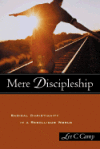
Mere Discipleship: Radical Christianity in a Rebellious World. By Lee C. Camp. Grand Rapids, MI: Brazos Press, 2003. 208 pgs. $14.99.


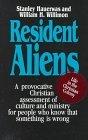
Resident Aliens: Life in the Christian Colony. By Stanley Hauerwas and William H. Willimon. Nashville, TN: Abingdon Press, 1989. 175 pgs. $16.00.


Though John Howard Yoder spent much of his career with a strange disinterest in academic publishing or scholarly recognition, he managed to leave an indelible mark on the landscape of contemporary biblical theology. His most well known work, The Politics of Jesus was among Christianity Today’s most important Christian books of the 20th C. and has continued to challenge prevailing evangelical assessments of just war and the relationship between church and state. Two offerings of Yoder’s progeny, one old and one new, carry the torch he lit in 1972 when PoJ was first published. In these volumes Stanley Hauerwas (professor of theological ethics at Duke Divinity school) and Lee Camp (assistant professor of Christian ethics at Lipscomb University) have sought to bring the insights of Yoder’s more technical work to a broader audience.

Although both works commend pacifism as inseparable from Christianity, the central thesis explored by Camp and Hauerwas can be appreciated by even the most committed just-war advocate; namely the vision of the Church as God’s kingdom, an alternative community to the kingdoms and cultures of this world. It is because these books herald that message so boldly that everyone who calls himself a conservative evangelical should probably read them every day and twice on Sunday. There are two flimsy poles anchoring the net of those who proudly wear that label. On one side there are the mega-Church marketers who offer salvation along with a free oil-change (while you drink a Gospel-ccino at the cafĂ© located in the church foyer) and on the other side there are those whose identity is so wrapped up in defending a list of propositions that if everyone were to suddenly agree, they would instantly kill themselves. What’s missing on both ends, of course, is the concept of a confident commonwealth marked out every bit as much by its practices as its propositions.

But the vision offered by Camp and Hauerwas is not the “best of both worlds” from these two outlooks, a melding of evangelistic zeal from the church growth movement and the community-exclusivity of the doctrinal vanguard. It is, rather, a radical critique of both of them in the hopes of an entirely new synthesis. The root of that critique is in the contention that from at least as far back as Constantine the Church has been co-opted by competing powers that remain under God’s judgment. By identifying our primary heritage as American (or anything other than the people of God – spiritual descendents of Abraham, Isaac and Jacob) we have implicitly bought into their story of the world, which is in direct conflict with the Biblical story. In so doing the Church loses its identity as an alternative path. Hauerwas notes: “Each age must come, fresh and new, to the realization that God, not nations, rules the world. This we can know, not through accommodation, but through conversion” (pg. 28). The cash value of this for evangelicals is to expose all of our unholy alliances which we routinely use as escape hatches from the Sermon on the Mount (i.e. American democratic ideals, conservative republicanism, consumerism, patriotic nationalism, etc.). These alliances (which both authors refer to as “Constantinianism” or “the Constantinian cataract) not only pervert Gospel definitions of concepts like freedom, religious liberty, fiscal responsibility and so on, but they virtually erase the lines between the church and the world in all matters public and political.

This, of course, relegates the Church to the backwoods of irrelevancy in public life; just one insipid offer of personal fulfillment among many. Instead of the Church being the evidence of God’s work in reclaiming the world, it becomes an optional resource for personal inspiration to those who would seek it. It’s no wonder that “witnessing” in this framework has become something less than testifying to God’s in-breaking kingdom evidenced in the formation of Spirit-filled communities who follow Jesus (not Caesar, not religious leaders, and not themselves) as their Lord.

Of the two books Camp does a much better job of appropriating these observations for popular consumption. By discussing these topics under the rubric of discipleship Camp delineates how pursuing God’s kingdom as a radical alternative to worldly common sense makes a difference in worship, baptism, prayer, communion and evangelism. It is seldom seen among conservative evangelicals how the agenda of the political right runs counter to our highest ideals as Christians, namely the worship of the One true God. Camp’s words poignantly reveal the conflict in quoting conservative political journalist George Will: “Will’s central thesis – a forthrightly idolatrous claim – is of great concern: ‘A central purpose of America’s political arrangements,’ Will claims, ‘is the subordination of religion to the political order, meaning the primacy of democracy.’” Although this chapter questionably marries this kind of analysis with the necessity of pacifism, it remains a pungent indictment of moral majority/religious right Christians. Camp’s insights on communion, table fellowship, the sharing of wealth and Jubilee theology is foreign to (and devastating for) the piously self-indulgent evangelicalism to which I belong. The opening quote from Albert Camus in Camp’s chapter on evangelism summarizes the sentiment of both books: “The world of today needs Christians who remain Christians.”

The derivative question of how Christians should think about war and violence is an important one, and these books offer substantial challenges to those who uncritically accept the necessity of participating in war, even among Christians. What fails to emerge from the criticism, however, is a comprehensive picture of how governments should conduct themselves in light of the sin that governs all individual human conduct. The “let the Gentiles do it” sort of attitude which dominates both works successfully avoids a theonomic solution to the problem, but never seriously grapples with the various ways in which loving one’s neighbor seems to entail promoting specific public policies. The question of how Christians should evaluate the merits of particular governments, as well as the degree to which they are carrying out their God-given function are left unanswered. Related to this weakness is the fact that both books fail to give an account of how Christian ethics can hold the nations of this world universally culpable and yet only be applicable for the community of faith.

Shining brightly through these sorts of theoretical weaknesses, though, is a breathtakingly Biblical view of the Church and its role in the world. Its time for the leaders of the evangelical world to wake up to the fact that the problems we commonly face in the church – division, moral decline, the moral failure of church leaders etc. – has less to do with to do with doctrinal aberrations than with our fundamental failure to follow Jesus. Consider the words of Yoder (quoted in the opening of Camp’s book):


Jesus was not just a moralist whose teachings had some political implications; he was not primarily a teacher of spirituality whose public ministry unfortunately was seen in a political light; he was not just a sacrificial lamb preparing for his immolation, or a God-Man whose divine status calls us to disregard his humanity. Jesus was, in his divinely mandated prophethood, priesthood and kingship, the bearer of a new possibility for human, social, and therefore political relationships. His baptism is the inauguration and his cross is the culmination of that new regime in which his disciples are called to share. Hearers or readers may choose to consider that kingdom as not real, or not relevant, or not possible, or not inviting; but . . . no such slicing can avoid his call to an ethic marked by the cross, a cross identified as the punishment of a man who threatens society by creating a new kind of community leading a radically new kind of life.