Having read Francis Watson's impressive and astute Paul and the Hermeneutics of Faith and being a huge fan of anything by Kevin Vanhoozer, I'm really looking forward to this little book. I've been interested in the topic of theological hermeneutics since I started reading the Scripture and Hermeneutics Series (I'm currently on volume six), and though I've seen others interact with him some, I've never read anything by Stephen Fowl. With the renewed interest in the topic (even recently spawning a new SBL study group) there's a torrent of literature available, which makes collections of essays one of the more efficient ways to keep up. Vanhoozer's recent book The Drama of Doctrine attempts to maintain propositional elements lost in postliberal approaches, and seeks to give standards for normative interpretation outside an often wayward Church without falling into the pitfalls of supposedly neutral "scientific" approaches. I'm interested in seeing his interaction with Fowl and Adam on the issue.Monday, October 09, 2006
Books I Just Bought
Having read Francis Watson's impressive and astute Paul and the Hermeneutics of Faith and being a huge fan of anything by Kevin Vanhoozer, I'm really looking forward to this little book. I've been interested in the topic of theological hermeneutics since I started reading the Scripture and Hermeneutics Series (I'm currently on volume six), and though I've seen others interact with him some, I've never read anything by Stephen Fowl. With the renewed interest in the topic (even recently spawning a new SBL study group) there's a torrent of literature available, which makes collections of essays one of the more efficient ways to keep up. Vanhoozer's recent book The Drama of Doctrine attempts to maintain propositional elements lost in postliberal approaches, and seeks to give standards for normative interpretation outside an often wayward Church without falling into the pitfalls of supposedly neutral "scientific" approaches. I'm interested in seeing his interaction with Fowl and Adam on the issue.Thursday, October 05, 2006
Being "Christian"
But judgment isn’t our only problem with our sin. We haven’t just come to realize that we are worthy of judgment, we’ve come to realize that our sins are, in fact, killing us. They’re destroying us. Everything that God has made, in all its beauty: food, drink, sex, the glories of nature, the creativity of human expression, all varieties of human relationships – all of these things which God has given us to enlarge our souls, to increase the capacity to have intimacy with Him, to reflect His own beauty – they’re tainted by our sin. The good in these things haven’t been destroyed by our sin, but they’ve been distorted and we abuse these things to our own hurt, which has led to the shrinking and shriveling of our souls. So instead of liberating us, we become enslaved to them.
And so our sin doesn’t just cause us to perish in judgment, it is the reason we ARE PERISHING, even now. We must answer Our Maker for our sins, and in the meantime we are being dehumanized by them. We’re not just the perpetrators of sin, we’re victims of sin – even our own. We’re not only awaiting eternal death in judgment, we’re dying now. We’re slaves to sin and the fear of death. So, what will we do?
Wednesday, September 13, 2006
Be a little Jewish - Read a Book
"One thing I noticed about Evangelicals is that they do not read. They do not read the Bible, they do not read the great Christian thinkers, they have never heard of Aquinas. If they're Presbyterian, they've never read the founders of Presbyterianism. I do not understand that. As a Jew, that's confusing to me. The commandment of study is so deep in Judaism that we immerse ourselves in study. God gave us a brain, aren't we to use it in His service? When I walk into an Evangelical Christian's home and see a total of 30 books, most of them best-sellers, I do not understand. I have bookcases of Christian books, and I'm a Jew. Why do I have more Christian books than 98 percent of the Christians in America? This is so bizarre to me."
- Dennis Prager in an interview from The Door magazine
Tuesday, September 05, 2006
Wars and Warnock
Yuck.
If you're interested in a lengthier evaluation, check out Broken Messenger for two excellent, insightful pieces.
"What is being taught in Christendom today is this; that since we have got the New Testament canon, since we have got the Word now, we do not need these direct interventions, we do not need God to speak to us directly, as He spoke to Abraham and to Isaac and to Jacob and these patriarchs. We have got the Word now! Is this superior to the direct speech of God? I think we are mad! There is no other word for this. We are mad. We are meant to be in a superior position to every Old Testament saint because of what has happened in our blessed Lord and Saviour! But this teaching would have us believe that we do not need this direct contact with God now, and that all that has come to an end since the formation of the New Testament canon . . . . .remember that the great point of the whole teaching of the Bible, of all you can deduce from it, is to tell you that God is a God who acts. And our only hope this afternoon is that this is still true. He has not finished acting. He is going on . . . There is only one hope. That is that He is still the living and the acting God. Christ is at His right hand, and He is seated and waiting until His enemies should be made His footstool . . . ."
I have been defending the faith—- and people have praised me for doing it. Rubbish! What a miserable failure it has all been! From now on I am determined to do one thing only, and that is to give God no rest nor peace, until He does prove Himself and show Himself. I have expended so much energy in reasoning with the people about this faith. We have got to do that, it is part of preaching. But if we stop at that, it will avail us nothing. But what I now am concerned about and I am concentrating on is this — asking God to show Himself, to do something,to give this touch, this manifestation of power. Nothing else will even make people listen to us . . . . Nothing is going to call the attention of the masses of the people to the truth of this faith save a great phenomenon, such as the phenomenon of the day of Pentecost, the phenomenon of any one of the great revivals, the phenomenon of a single changed life. This is something that always arrests attention, maybe curiosity — what does it matter? The people come and listen . . . .
We must not be content until we have had some manifestation of the activity of God. We must concentrate on this. This is my plea, that we concentrate on this, because it is the great message of the Bible Let us put it like this: Do we really believe that God can still act? That is the question; that is the ultimate challenge. Or have we, for theological or some other reasons, excluded the very possibility? Here is the crucial matter. Do we individually and personally really believe that God still acts, can act and will act — in individuals, in groups of individuals, in churches, localities, perhaps even in countries? Do we believe that He is as capable of doing that today as He was in ancient times — the Old Testament, the New Testament times, the book of Acts, Protestant Reformation, Puritans, Methodist Awakening, 1859, 1904-5? Do we really believe that He can still do it? You see, it is ultimately what you believe about God. If He is the great Jehovah — I am that I am, I am that I shall be, unchanged, unchanging, unchangeable, the everlasting and eternal God — well, He can still do it.”
Tuesday, August 29, 2006
K.J.V. Only (Well, not ONLY . . .)
Though I’ve mentioned my appreciation for him before, I didn’t really realize that I was a Vanhoozer fanboy until today, so I haven’t given much thought as to why that is – but here’s a Rorschach-shaped reactionary first guess:
He’s a both a scholar AND self-consciously Christian: In every book and lecture it’s abundantly clear that Vanhoozer’s interests aren’t just academic – he sees theology as fundamentally a task for the Church to be done by the Church. While many claim to be interested in a theology which refuses to divorce knowledge from practice Vanhoozer actually makes the Church’s practice a fundamental factor in theorizing about doctrine. But beyond this, all of his scholarship begins with rigorous Christian foundations, making use of Christian resources to answer hermeneutical and theological problems. For all of his kind and critical engagement, he never pretends that Christianity is a peer among equals in the marketplace of ideas. Scripture has always taken an unapologetically central role in his work (a fact not easily recognized if all you’re doing is looking for references in an index). Moreover, his scholarship is actually an astonishing testimony of the Spirit’s work, as it intentionally aims at love, joy, peace, patience, kindness, goodness, faithfulness, gentleness, self-control and humility – a rare commodity in this level of scholarship (and an even rarer commodity in the robustly Reformed circles Vanhoozer resides).
- He engages postmodernism both critically AND thoughtfully: Though Vanhoozer has, in his words, “cooled to speech-act theory” as a solution for every problem presented by postmodern criticism, his book Is There a Meaning in This Text? is near universally acclaimed as one of the most impressive and even-handed criticisms of postmodernism by someone arguing for authorial intention. His most recent offering in DoD does for postliberal theology what Is There a Meaning? did for postmodern literary theory, harvesting the wheat and leaving the chaff. His disposition of “disputation” (for an explanation, see another wonderful contribution of Vanhoozer’s in Christianity and the Postmodern Turn: Six Views) in regard to contemporary offerings is able to mine the gems without collecting rocks.
He’s thought-provoking AND funny: Much like N.T. Wright, there’s a subtle wit about Vanhoozer’s presentation that is fun to read and even more fun to hear. Puns, double-entendre, and other wry humor is littered through every article, book and lecture in a way my brother finds annoying, but I rather enjoy. Glance through his response to Paul Helm at Reformation 21 and the corner of your mouth is bound to curl a few times.
- He’s theologically creative AND traditional: One of the most encouraging things about Vanhoozer’s work is that it pushes in new directions without being detached from the various anchors of faithfully Biblical scholarship. Beyond affirming all of the vanilla creeds, Vanhoozer’s commitment to Scripture’s perfection, authority and necessary guidance for the Church stands out from other scholars of his caliber. Like so few constructive theologians, Vanhoozer is able to employ new metaphors, develop new frameworks and offer critical evaluation of older models without pulling at the fundamental roots of Christian belief and practice - and maybe more significantly, without ever losing his distinctively evangelical commitment. Even when I find myself in something less than enthusiastic agreement with him (which, of course, I sometimes do – I’m a fanboy, not a cult member), his proposals never raise my hackles as pushing the limits too far.
- He’s profound AND prolific: The challenging and thought-provoking material isn’t only daunting in its quality, but in its quantity. As with N.T. Wright, there’s never fear that you’ll be left wanting more – there’s too much already. There are at least five books he’s edited or written which I’d still like to read, given enough time - including his Cambridge Companion to Postmodern Theology, Biblical Narrative in the Philosophy of Paul Ricoeur: A Study in Hermeneutics and Theology and The Trinity in a Pluralistic Age: Theological Essays on Culture and Religion.
Thursday, August 17, 2006
After Virtue, pt. 2
Speaking of virtue, he says:
The virtues therefore are to be understood as those dispositions which will not only sustain practices and enable us to achieve the goods internal to practices, but which will also sustain us in the relevant kind of quest for the good, by enabling us to overcome the harms, dangers, temptations and distractions which we encounter, and which will furnish us with increasing self-knowledge and increasing knowledge of the good. The catalogue of the virtues will therefore include the virtues required to sustain the kind of households and the kind of political communities in which men and women can seek for the good together and the virtues necessary for philosophical enquiry about the character of the good. We have then arrived at a provisional conclusion about the good life for man: the good life for man is the life spent in seeking for the good life for man, and the virtues necessary for the seeking are those which will enable us to understand what more and what else the good life for man is.
I'm not a philosopher - and though reasonably intelligent, I'm not very well-informed on topics such as these. At best, I'm a curious fellow with too much time on his hands, so any criticism has to be taken with a grain of salt and without the expectation that Alasdair MacIntyre will fall upon his pen upon reading my critique - but I do have at least one major misgiving with his conception of ethics, as I've understood it (or, more likely, as I've failed to understand it). What seems to be lacking is the role that Truth (capital 'T') might play in moral discourse. I can't see how what MacIntyre is doing in this book isn't just a kind of pragmatism which, at best, can provide intelligibility for ethics, but is ulimately very little help in actual moral discourse. The lack of some kind of standard or rule by which both community and telos can be measured makes appropriating this sort of thing kind of difficult.
Tuesday, August 08, 2006
Pomo Showdown
UPDATE: I've just read Macht and Joel Hunter's comments on Wilson's review, which both state that Wilson has dodged, missed or otherwise entirely avoided Smith's point - that's what I get for talking about a book I've never actually read. In any case the one thing that Wilson does bring up, which I'd like to hear someone address, is the question I raised in this post: How are people to ajudicate between rival interpretations without falling prey to stock postmodern criticisms? If everyone ultimately can only evaluate other interpretations from the standpoint of their own, what's the way out of that particular cul-de-sac? C'mon, Joel, I said HELP!!!
Doug Wilson just posted a tantalizing review of J.K.A. Smith's book, Who's Afraid of Postmodernism? I've been wanting to pick this one up since it was commended to me by Sir Bryan Lee, my good friend and Captain of the Intelligently Postmodern Brigade. I have to say, at first glance, I have a feeling I'd probably be more sympathetic to Wilson's take.
I'll be posting a bit more about Alasdair MacIntyre's After Virtue shortly, but Wilson's comments give voice to nagging concerns even as I've enjoyed the book thus far - namely the fear that once MacIntyre has destroyed the blighted secularism which has given birth to the current moral crises of our day, his sociological analysis will be powerless to commend a truly Christian alternative. The questions raised by Wilson are all the same ones I've come up against in reading Lindbeck and Hauerwas - they are so robustly and self-confidently Christian it's positively exhilerating - until the issue of engagement comes to the fore. For all the pitfalls of "cognitive-propositional" models of doctrine, and all the benefits of a narrative approach, how does a particular person's narrative climb out of the spongy morass of pluralism to assert itself without falling prey to the same criticisms as Enlightenment positivism? How can the Gospel be proclaimed without the Sitz im Leben of one hors'dourve being offered from a tray of several equally tasty choices?
I think Reformed resources provide the the only theologically viable raw material for a Biblically sustainable alternative - Plantinga's modest foundationalism, Vanhoozer's chastised version of intentionality, and Wright's critical realism are a good start (yeah, I said N.T. Wright: there's a lot more Reformed people should appreciate about the guy, Piper's latest sermon notwithstanding). The more I listen to someone like Tim Keller, the more I'm convinced of Reformed theology's potential value in navigating the postmodern world.
However necessary and beautiful the call to community formation, these authors inevitably blunt the imperial force of the Gospel, which is wrapped up in Jesus' lordship - or do they? Joel Hunter, the resident postmodern poster-boy at the Boar's Head Tavern, if you're reading this - help!
I'll be posting a bit more about Alasdair MacIntyre's After Virtue shortly, but Wilson's comments give voice to nagging concerns even as I've enjoyed the book thus far - namely the fear that once MacIntyre has destroyed the blighted secularism which has given birth to the current moral crises of our day, his sociological analysis will be powerless to commend a truly Christian alternative. The questions raised by Wilson are all the same ones I've come up against in reading Lindbeck and Hauerwas - they are so robustly and self-confidently Christian it's positively exhilerating - until the issue of engagement comes to the fore. For all the pitfalls of "cognitive-propositional" models of doctrine, and all the benefits of a narrative approach, how does a particular person's narrative climb out of the spongy morass of pluralism to assert itself without falling prey to the same criticisms as Enlightenment positivism? How can the Gospel be proclaimed without the Sitz im Leben of one hors'dourve being offered from a tray of several equally tasty choices?
However necessary and beautiful the call to community formation, these authors inevitably blunt the imperial force of the Gospel, which is wrapped up in Jesus' lordship - or do they? Joel Hunter, the resident postmodern poster-boy at the Boar's Head Tavern, if you're reading this - help!
Friday, July 28, 2006
Who Said the Following (NO GOOGLING!!!)
In light of the series of posts about justification going on over at Pyromaniacs, I thought I'd give the following quiz, just for funsies. So, without using any technological wizardry, like internet search engines, tell me: who said the following?
Nevertheless, we must also own up to the fact that our final salvation is made contingent upon the subsequent obedience which comes from faith. The way these two truths fit together is that we are justified on the basis of our first act of faith because God sees in it (like he can see the tree in an acorn) the embryo of a life of faith. This is why those who do not lead a life of faith with its inevitable obedience simply bear witness to the fact that their first act of faith was not genuine.
The textual support for this is that Romans 4:3 cites Genesis 15:6 as the point where Abraham was justified by God. This is a reference to an act of faith early in Abraham's career. Romans 4:l9-22, however, refers to an experience of Abraham many years later (when he was 100 years old, see Genesis 2l:5,l2) and says that because of the faith of this experience Abraham was reckoned righteous. In other words, it seems that the faith which justified Abraham is not merely his first act of faith but the faith which gave rise to acts of obedience later in his life. (The same thing could be shown from James 2:2l-24 in its reference to a still later act in Abraham's life, namely, the offering of his son, Isaac, in Genesis 22.) The way we put together these crucial threads of Biblical truth is by saying that we are indeed justified on the basis of our first act of faith but not without reference to all the subsequent acts of faith which give rise to the obedience that God demands.
Now the more difficult question: why is it important? Why are the deeds done in the body the evidence in this courtroom? Is the aim of this judgment to declare who is lost and who is saved, according to the works done in the body? Or is the aim of this judgment to declare the measure of your reward in the age to come according to the works done in the body? I think the answer of the New Testament is both. Our deeds will reveal who enters the age to come, and our deeds will reveal the measure of our reward in the age to come . . .
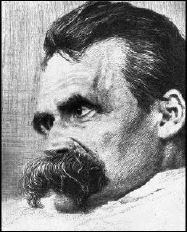
There will be a small prize for those who guess all four correctly without any fancy-doodle internet searching (the pictures are suggestive, not necessarily indicative of the author)!
Tuesday, July 25, 2006
The Prophet
My lonely heart athirst, I trod
A barren waste when, so t'was fated,
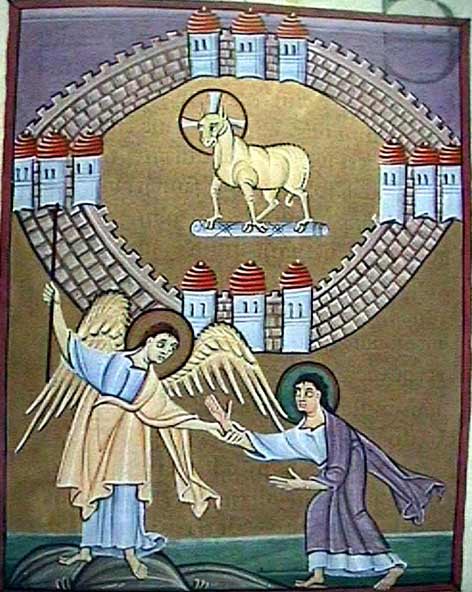
a winged serapy 'fore me stood:
Where crossed the desert roads he waited.

Upon my orbs of sightless clay
His fingers lightly he did lay,
And like a startled eagle round me
I gazed and saw the earth surrounded,
Hemmed by sky . . . He touched my ear,
Then t'other, and most marked and clear,
There came to me the gentle flutter
Of angel's wings, I heard the vine
push through the earth and skyward climb,
the deep-sea monsters in the water,
like tiny fishes glide. . . . And o'er
Me calm he bent and out he tore
my sinful tongue . . . not once withdrawing
His gaze from mine, he pushed, unseen
a serpent's deadly sting between
my ice-cold lips . . . Then swiftly drawing
His shining sword, he clove my breast,
Plucked out my quivering heart, and sombre
And grim of aspect, cooly thrust
Into the gaping hole an ember
That ran with flame . . . I lay there, dead
And God, God, spake, and this He said:

"Arise O sage, and my call hearing,
Do as I bid, be naught deterred.
Stride o'er the earth a prophet searing,
The hearts of men with rightoues word."
Aleksandr Pushkin
1826
(translated by Irina Zheleznova)
A barren waste when, so t'was fated,
a winged serapy 'fore me stood:
Where crossed the desert roads he waited.
Upon my orbs of sightless clay
His fingers lightly he did lay,
And like a startled eagle round me
I gazed and saw the earth surrounded,
Hemmed by sky . . . He touched my ear,
Then t'other, and most marked and clear,
There came to me the gentle flutter
Of angel's wings, I heard the vine
push through the earth and skyward climb,
the deep-sea monsters in the water,
like tiny fishes glide. . . . And o'er
Me calm he bent and out he tore
my sinful tongue . . . not once withdrawing
His gaze from mine, he pushed, unseen
a serpent's deadly sting between
my ice-cold lips . . . Then swiftly drawing
His shining sword, he clove my breast,
Plucked out my quivering heart, and sombre
And grim of aspect, cooly thrust
Into the gaping hole an ember
That ran with flame . . . I lay there, dead
And God, God, spake, and this He said:
"Arise O sage, and my call hearing,
Do as I bid, be naught deterred.
Stride o'er the earth a prophet searing,
The hearts of men with rightoues word."
Aleksandr Pushkin
1826
(translated by Irina Zheleznova)
Friday, July 21, 2006
After Virtue, pt. 1
One of the most common criticisms about Christian morality in the public square is that it is fundamentally sectrian. The accusation of tribalism is probably the most frequently cited evidence of religion's failure to provide ethical norms which can lead humanity out of the intractable moral debates and political tensions in which we find ourselves. Public reason, it is said, must necessarily exclude private religious conviction if there is to be any hope for positive political solutions to issues such as abortion, sexual and racial exclusion, millitary agression, economic imperialism, and the like.
This discussion is leading up to MacIntyre's account of the failure of the Enlightenment and the modern project to provide rational grounds for moral justification - but even at this point the implications of his argument are startling. It extends a problem which is typically characterized as a religious one - namely, how should believers participate in making public policy for those who don't share their beliefs - to the secular kingdoms of this world. On what grounds can anyone justify their public policy recommendations? If it can't be "reason" or "rationality", what's left of secular resources to answer the question?
Wednesday, July 12, 2006
Here Comes the Judge . . .
Some form of the word " judgment" appears 4 times in these three verses (although the word really has more of the idea of investigation than the final banging of a gavel – that’s why the NAS translates it "examine”), which highlights the activity of skeptical, destructive criticism. Another way of reading it might be “It’s a very small thing to me to be cross-examined by you.” I think these verses are particularly noteworthy in the blogosphere, if for no other reason than for just how bold a response it is to those who are acting as judge. It's hard to imagine recommending that someone respond to another believer’s criticisms by saying, “Honestly, your opinion means very little to me – in fact, they mean next to nothing. So anyway . . . thanks!”
Yet that's effectively what Paul did.
But what he was up against wasn't loving believers holding one another accountable for their sin - it was the same kind of overbearing, finger-pointing, camel-swallowing, gnat-straining, foaming-at-the-mouth, fault-finding false judgment that Jesus rebuked in the Pharisees. Those who have been blogging for long know what this is like, those who don't even know what a blog is should probably just take a moment to thank Jesus right now. If you're unsure about what this looks like, and have a stomach that's a bit too sensitive for checking out some of the fire-and-blogstone for yourself, just take a peek at Matthew 23:1-13. Jesus illustrates the the problem well with those in His own day who were "sitting in the seat of Moses", "tying up heavy loads" to lay upon people without "lifting a finger" to help, and in all other ways barring people from the kingdom of heaven.
However the Corinthians were evaluating Paul, we know that their determinations of the value of his ministry (and their arrogant assumptions about God's evaluation of it) didn't mean much to him because, as 1 Co. 4:1-2 said, he's Christ's slave, not theirs. It’s only on the “day of the Lord” that these things will be made known, and the Corinthians will be standing next to him, not over him.
But Paul wasn’t just saying that the Corinthians had no right to judge these things – look again at verse 3: he said that even he HIMSELF had no right to judge. That’s a profound thing to think about. God is judge not just because it’s His sovereign right and not yours (even though that’s true), but because He’s the only One wise enough to do it. So it’s not just that you shouldn’t judge other slaves of Christ, you should realize that you CAN’T really judge them – you can’t even judge yourself!
I know there is a great aptness in men who suppose they have had some experience of the power of religion, to think themselves sufficient to discern and determine the state of others by a little conversation with them; and experience has taught me that this is an error. I once did not imagine that the heart of man had been so unsearchable as it is. I am less charitable, and less uncharitable than once I was. I find more doings in wicked men that may counterfeit, and make a fair show of piety; and more ways that the remaining corruption of the godly may make them appear like carnal men, formalists, and dead hypocrites, than once I knew of. The longer I live, the less I wonder that God challenges it as his prerogative to try the hearts of the children of men, and directs that this business should be let alone till harvest. I desire to adore the wisdom of God, and his goodness to me and my fellow–creatures that he has not committed this great business into the hands of such a poor, weak, and dimsighted creature; one of so much blindness, pride, partiality, prejudice, and deceitfulness of heart; but has committed it into the hands of one infinitely fitter for it, and has made it his prerogative.Those who others regard as "mature, godly and discerning” are often the ones who turn out to be hypocrites. And those who appear “weak, immature and gullible” are often the ones who grow in grace beyond everyone’s expectations. Edwards came to learn that “victorious Christian living” really is ultimately all about keeping your eyes on your own work, being faithful in your own service, with the earnest desire that it will please your Lord, to whom you will give an account when He returns. And that means you shouldn't necessarily care for the "authoritative" praises or condemnations of other insignificant slaves, even if they have dressed themselves up as popes, and they certainly aren’t out to get their master’s job as Lord and Judge. God help us to be faithful slaves.
Friday, June 30, 2006
Victory in Jesus?
Christian culture encourages us to actively hide our foolishness because we’re the ones that are supposed to have all the answers. It makes us experts at covering up our own weaknesses so that other Christians will think we’re strong and unbelievers will know that we’re not sinners, like they are. And that, my friends, is an affront to the cross. When we do everything possible to convince both ourselves and others that we’re really decent, prudent, mature Christians who’ve basically got it all together, the inevitable result is that we not only not only reject God's Holy Spirit, but we deny our ongoing need as sinners for atonement, forgiveness and mediation. When our attempts to be thought strong, wise and noble become habitual, and we've successfully convinced ourselves of our maturity, the eventual result is a marginalizing and ostracizing those who are actually openly weak among us. We create a culture of fear so that openly admitting our weaknesses and foolishness becomes the scariest thing imaginable and appearing impenetrable is a desirable standard of holiness. And maybe our motives are good – we want unbelievers to see that Jesus really has changed us and we want other Christians to know that we really are saved and that we really do know God. But God is brutally honest about the fruit of wanting to be considered wise, strong and noble by others; and that fruit is precisely the mess we read about in stories like the one linked above. May He have mercy on us while we struggle to come to terms with the depth of our sin and the lying standards of perfection which so often nullify God's grace in Jesus.
Saturday, June 17, 2006
Ack!
UPDATE (6/22): Apparently Brandon Witherow, a Ph.D candidate at Westminster Seminary has been following the accusations of lubricious heresy hunters surrounding Enns' book. Both his reactions to the exchange chronicled below as well the links to previous discussions of the book are worth checking out.
UPDATE (6/18): Steve has since posted a few new comments which both persist in missing my point and ironically label me as "angry" - I'd be happy to respond in more detail to anyone who's interested - just post a comment here; but judging from the level of vitriol gushing from his responses, and an apparent preference for "sniping" rather than talking, responding any further seems pointless. iMonk has posted some reactions to the venom which, in Steve's zeal, splashed onto him from the response to me.
That's one of the noises one makes when gurgling in his own blood, which was a metaphorical posture I took while reading Steve Hays eviscerate a few of my last posts. Steve kindly refers to me as talented, for which I'm genuinely flattered. It gets a bit ugly from there, though, as I'm subsequently referred to as cocky, juvenile and immature (which, of course, I am from time to time). Most of what motivates the (dare I say) overly harsh critique, it seems, were my comments about Don Carson (which, at second glance did come off as far snootier than I had intended). In any case, it clearly pricked a nerve, and I'm sorry.
But I hadn't intended anything like what Steve fears I meant - namely that Carson is somehow "out of touch". The point I was making, in fact, depends very much on the opposite evaluation. That point, again, is that many students within conservative evangelical circles have been nurtured on the very over-simplifications, glib harmonizations and anachronisms that Enns is addressing. Carson may take much of what Enns says as "obvious" and "unnecessary" and "less than ground-breaking", pointing to nuances that many scholars commonly accept when it comes to issues like ANE parallels and cultural situatedness in Scripture - but this book wasn't written for them. That's why the bibliographies offered by Steve in his vigorous response to my comments are helpful, but completely irrelevant.
The helpfulness of the book is its honest presentation of the challenges presented by the Old Testament - a presentation that may linger irritatingly for OT scholars to whom the issues are old hat (and to a more educated audience like Steve, who are anxious to rush to their preferred answers to long-known questions). But for new students who are newly coming to grips with these glaringly terrestrial marks of Scripture, it is an exceedingly wise introduction because it takes their context seriously - namely that of the raging Bible wars between liberals and conservatives, marked by a posture of defense in conservative evangelical churches. The "doceticism" described by Enns in relation to the Bible is, in my judgment, a wise strategy for acknowledging the popular emphasis on Scripture's heavenly origin over against marks of its human composition. That - not an attempt to present a comprehensive theological (or hermeneutical) model for understanding Scripture - is the goal of this book. That's also why Carson's desire for a more detailed exposition of the incarnation analogy misses the point. Again, my criticism wasn't that Carson is an idiot - it's the opposite. He's an impressively credentialed biblical scholar. But this book wasn't written to whet his academic appetite, it was written to deal with what can be a crisis for students who have consistently heard only one side of the story.
It's important to point out that this was really my main criticism of both Carson and Helm. You'll see that at the end of my comments I noted that I felt both of their criticisms, cautions and suggestions weren't inappropriate. Neither my review, nor the book, implies that there haven't been real attempts to solve the kind of universally acknowledged theological and hermeneutical difficulties which Enns discusses, that Enns is somehow dealing with issues no one has ever dealt with before, or that conservatives have somehow "locked away evidence". You'll not find any of those sentiments in my review, and Steve's recitation of well-known books and authors don't refute claims that I never made. Neither did I claim that these men were oblivious to the various debates and difficulties in the OT, or that Enns was particularly ground-breaking in his approach to the difficulties. What I did say, and am still saying, is that Enns is to be commended for knowing his audience - he's not a Tubingen liberal speaking to an academic audience. He's a Reformed, conservative evangelical speaking to conservative evangelical students. He realizes (in a way that I think Carson didn't take into account) that he's not talking to "Arians", but to many who have been gorged to excess on apologetic discourses on the timeless, enduring, and heavenly qualities of the Bible and, when confronted with its cultural moorings, are coming to a point of crisis. Characterizing such a demographic as "angry young men" both illustrates and exacerbates the problem Enns is trying to address.
There's more to say, especially about Steve's suggestions about apostolic exegesis (and perhaps about Enns repeated assertions that demonstrate his unwillingness to admit of "errors"), and perhaps I'll do that later. But I should probably end my explanation with a reminder about the mode of communication being utilized here. Blogs, for me, anyway, are somewhere in between an email and an essay, both in their manner of expression and their content. Like an email they are often informal codifications of a person's thoughts, and aren't meant to be taken with the precision of a serious publication. So while they bear certain marks of an essay, with argumentation, critical reflection and even a certain polemical edge, they shouldn't be taken as final pronouncements as much as an invitation for discussion. More importantly, like email, they're not very good reflections of what a person is really like. Steve seems to take me for an unfortunate blend of talent and egomania. I fear that this appraisal may come from taking me even more seriously than he's convinced I take myself. His apparent distaste for my presence at the Boar's Head Tavern, for instance, seems to assume that its very much like a denominational association of some kind rather than an attempt to meet new people, make new friends, and talk about areas of interest. After feeling thoroughly clobbered by his comments it did me some good to remember the potential for distortion refracted by what bloggers write during a few minutes of distraction from the rest of their busy lives.
UPDATE (6/18): Steve has since posted a few new comments which both persist in missing my point and ironically label me as "angry" - I'd be happy to respond in more detail to anyone who's interested - just post a comment here; but judging from the level of vitriol gushing from his responses, and an apparent preference for "sniping" rather than talking, responding any further seems pointless. iMonk has posted some reactions to the venom which, in Steve's zeal, splashed onto him from the response to me.
But I hadn't intended anything like what Steve fears I meant - namely that Carson is somehow "out of touch". The point I was making, in fact, depends very much on the opposite evaluation. That point, again, is that many students within conservative evangelical circles have been nurtured on the very over-simplifications, glib harmonizations and anachronisms that Enns is addressing. Carson may take much of what Enns says as "obvious" and "unnecessary" and "less than ground-breaking", pointing to nuances that many scholars commonly accept when it comes to issues like ANE parallels and cultural situatedness in Scripture - but this book wasn't written for them. That's why the bibliographies offered by Steve in his vigorous response to my comments are helpful, but completely irrelevant.
It's important to point out that this was really my main criticism of both Carson and Helm. You'll see that at the end of my comments I noted that I felt both of their criticisms, cautions and suggestions weren't inappropriate. Neither my review, nor the book, implies that there haven't been real attempts to solve the kind of universally acknowledged theological and hermeneutical difficulties which Enns discusses, that Enns is somehow dealing with issues no one has ever dealt with before, or that conservatives have somehow "locked away evidence". You'll not find any of those sentiments in my review, and Steve's recitation of well-known books and authors don't refute claims that I never made. Neither did I claim that these men were oblivious to the various debates and difficulties in the OT, or that Enns was particularly ground-breaking in his approach to the difficulties. What I did say, and am still saying, is that Enns is to be commended for knowing his audience - he's not a Tubingen liberal speaking to an academic audience. He's a Reformed, conservative evangelical speaking to conservative evangelical students. He realizes (in a way that I think Carson didn't take into account) that he's not talking to "Arians", but to many who have been gorged to excess on apologetic discourses on the timeless, enduring, and heavenly qualities of the Bible and, when confronted with its cultural moorings, are coming to a point of crisis. Characterizing such a demographic as "angry young men" both illustrates and exacerbates the problem Enns is trying to address.
Thursday, June 15, 2006
Who Knew . . .
You scored as Karl Barth. The daddy of 20th Century theology. You perceive liberal theology to be a disaster and so you insist that the revelation of Christ, not human experience, should be the starting point for all theology.
Which theologian are you? created with QuizFarm.com |
Tuesday, June 13, 2006
"Enns-piration" pt. 2
Enns isn’t the first to suggest the incarnation as a theoretical model in which to understand Scripture, but his articulation of it does put him at odds with certain sectors of his own tradition. The book has drawn some criticism, in part from those who remain puzzled that more people aren’t aware of Gleason Archer’s definitive resolution of these issues years ago. Others simply dismiss it on the grounds that the Westminster confession never envisioned the proposal. But it’s also drawn criticism from more notable evangelical stalwarts. In his review, Paul Helm, Emeritus professor of philosophy at the University of London, called the book a superficial theological and epistemological “failure”. Don Carson, in a tripartite review, criticized the book for giving more space to fighting the “docetist” (i.e. the over-emphasis on the divine) than to fighting the Arian (i.e. the over-emphasis on the human). In the end he finds Enns to be decidedly “non-pastoral”. Unfortunately (and ironically) the criticisms are more troubling than anything in the book, because they fail to take seriously both the audience and the pastoral problems which Enns is addressing.
The fact is that evangelical pulpits typically ram an apologetic agenda through the text of the Old Testament to the degree that the text becomes a side-issue. Maybe I’m in the backwoods of conservative evangelicalism, but I’ve never heard a sermon in Genesis that didn’t comprise your basic “creation vs. evolution” seminar. I’ve never heard about ANE parallels and similarities to ANYTHING in the Law (much less the creation story) coming from the pulpit. Moreover, I’ve never, not once, heard the call to honor the Scripture’s diversity coming from my Sunday School class, and the models for resolving “apparent conflicts” which were held out to me have consistently been the voices of steam-rolling harmonization. What both Carson and Helm seem to miss is that this experience is much more typical than they’d like to admit, and the failure for evangelical scholars to admit it is one of the chief reasons doubt arises in the hearts of young students who have been nourished on the very over-simplifications and polarizations Enns is seeking to correct. In other words, where Carson wants scholarly nuance and fine-tuning in Enns’ characterizations are precisely the points at which most haven’t ever heard such nuance and fine-tuning. And that’s the point of this book. Many of those who would reject the tenents of this book would be equally queasy about the Longman book Carson recommends instead. Though Carson’s first criticism is that Enns doesn’t really understand his audience, the shoe appears to be on the other foot – it’s Carson who doesn’t seem to understand the dissatisfaction of disaffected students who are looking for evangelical scholars to recognize the polarized messages they’re actually hearing in their pulpits and classrooms (a longing he labels “the angry young man syndrome”).
Enns book really seeks to stimulate the imagination as to how the Bible can be a product of human culture and still be the divine Word of God. His answers are meant to be suggestive, not comprehensive, and though Carson states his criticisms as not “to ask Enns to write an entirely different book”, that, in the end, are what his criticisms amount to. Helm’s review falters under a grosser failure, namely the refusal to reckon with the core of Enns’ vision, which will resonate in the minds of many students – namely that the actual phenomena of Scripture (not merely Scriptural affirmations of its reliability) should be at the bottom floor in formulating our understanding of how Scripture works. Instead, he simply states that “he starts at the wrong end”. That accusation misses the point not only because starting with the phenomena of Scripture IS HIS PROPOSAL, but also because of the degree to which apologetics has defined the agenda in conservative sectors of OT studies, and have fueled the very excesses the book seeks to curb. Both Carson and Helm glibly bypass the most difficult examples of diversity within the OT canon, Carson by offering his own potential harmonization of the less significant examples and Helm by skipping the actual data altogether (how Helm can accuse him of “fideism” and at the same time recommend “staring from dogma instead of difficulties” is beyond me). For these reasons, and a few more from which I will spare you, I believe Inspiration and Incarnation stands up under scrutiny; not because the criticisms are devoid of useful critiques, appropriate cautions or valid suggestions, but because Enns' words, like apples of gold in settings of silver, are provocatively delivered in exactly the right circumstances.
Saturday, June 10, 2006
Evy said "No"
Monday, June 05, 2006
"Enns-piration"
Enns’ basic thesis is that a doctrine of Scripture should arise from the Scriptures themselves. Well, duh. But as you might expect, that recommendation turns out to be much more controversial than it initially sounds, because Enns is concerned not only about conforming our doctrine of Scripture to the Biblical testimony of its authority but to the phenomena of Scripture itself – with all its cultural moorings, rich diversity and strange uses of previous texts. These three issues only become problems in need of creative explanation if one develops expectations of Scripture from outside Scripture – which is precisely Enns’ critique of modern notions of inspiration. The result of such modern formulations is that interpretation becomes an exercise in a rather shifty brand of apologetics – ANE parallels are completely ignored in order to make the Bible appear culturally timeless; texts with genuinely different perspectives are forcibly crammed into a homogenized goo in order to make the Bible appear seamlessly harmonized; the hopelessly unscientific method with which Scripture uses Scripture is either dressed up as historical-grammatical exegesis or unconvincingly privileged as a non-repeatable apostolic privilege – all from a desire to rid the Bible from any signs of being a genuinely human (as well as divine) production.
The answer to such distortion, says Enns, is to see the written Word of God functioning according to the same nature as the incarnate Word of God – a perfect symbiosis of humanity and divinity. Jesus perfectly revealed the Father not as a hovering wraith or Docetic illusion, but as a genuine 1st C. Jewish man. He spoke the language, lived and participated within ancient Palestinian culture, and displayed all of the creaturely dependence requisite to humanity. He wasn’t a god just pretending to be a man, as so many seem to believe (and then wonder why they’re not moved by the stories of suffering and crucifixion in the Gospels). He was God anchored in time, culture and finite dependence upon the Father. The written Word of God should be understood as revealing the Father in the same way. As evangelicals continue to thrash about over theories of inspiration, some are drowning and others are barely treading water while the actual content of the Bible – in all of its varied and richly enculturated glory – circles the drain. In the next week or so, as I have time, I’ll be posting an evaluation of some of the criticisms I’ve read (from the likes of such Reformed luminaries as Paul Helm). In the meantime, Inspiration and Incarnation: Evangelicals and the Problem of the Old Testament is required reading.
Thursday, June 01, 2006
Subscribe to:
Posts (Atom)