Friday, July 28, 2006

Who Said the Following (NO GOOGLING!!!)

In light of the series of posts about justification going on over at Pyromaniacs, I thought I'd give the following quiz, just for funsies. So, without using any technological wizardry, like internet search engines, tell me: who said the following?

A. What we are trying to do here is own up to the teaching of Romans 5:1, for example, that teaches that we are already justified before God. God does not wait to the end of our lives in order to declare us righteous. In fact, we would not be able to have the assurance and freedom in order to live out the radical demands of Christ unless we could be confident that because of our faith we already stand righteous before him.

Nevertheless, we must also own up to the fact that our final salvation is made contingent upon the subsequent obedience which comes from faith. The way these two truths fit together is that we are justified on the basis of our first act of faith because God sees in it (like he can see the tree in an acorn) the embryo of a life of faith. This is why those who do not lead a life of faith with its inevitable obedience simply bear witness to the fact that their first act of faith was not genuine.

The textual support for this is that Romans 4:3 cites Genesis 15:6 as the point where Abraham was justified by God. This is a reference to an act of faith early in Abraham's career. Romans 4:l9-22, however, refers to an experience of Abraham many years later (when he was 100 years old, see Genesis 2l:5,l2) and says that because of the faith of this experience Abraham was reckoned righteous. In other words, it seems that the faith which justified Abraham is not merely his first act of faith but the faith which gave rise to acts of obedience later in his life. (The same thing could be shown from James 2:2l-24 in its reference to a still later act in Abraham's life, namely, the offering of his son, Isaac, in Genesis 22.) The way we put together these crucial threads of Biblical truth is by saying that we are indeed justified on the basis of our first act of faith but not without reference to all the subsequent acts of faith which give rise to the obedience that God demands.

B. When we stand before Christ as Judge we will be judged according to our deeds in this life. "For we must all appear before the judgment seat of Christ that each one may be recompensed for his deeds in the body, according to what he has done, whether good or bad (2 Co. 5:10)." This is not an isolated teaching in the New Testament. Jesus said in Matthew 16:27, "The Son of Man is going to come in the glory of His Father with His angels; and will then recompense every person according to his deeds." And in the very last chapter of the Bible Jesus said, "Behold, I am coming quickly, and my reward is with me, to render to every person according to what he has done" (Rev. 22:12). In other words the way you live is not unimportant.

Now the more difficult question: why is it important? Why are the deeds done in the body the evidence in this courtroom? Is the aim of this judgment to declare who is lost and who is saved, according to the works done in the body? Or is the aim of this judgment to declare the measure of your reward in the age to come according to the works done in the body? I think the answer of the New Testament is both. Our deeds will reveal who enters the age to come, and our deeds will reveal the measure of our reward in the age to come . . .

How then can I say that the judgment of believers will not only be the public declaration of the measure of our reward in the kingdom of God according to our deeds, but will also be the public declaration of our salvation—our entering the kingdom—according to our deeds? The answer in a couple sentences is that our deeds will be the public evidence brought forth in Christ's courtroom to demonstrate that our faith is real. And our deeds will be the public evidence brought forth to demonstrate the varying measures of our obedience of faith (cf. Rom. 12:3; 1Thess. 1:3; 2 Thess. 1:11). In other words, salvation is by faith, and rewards are by faith, but the evidence of invisible faith in the judgment hall of Christ will be a transformed life. Our deeds are not the basis of our salvation, they are the evidence of our salvation. They are not foundation, they are demonstration.

C. And we now discover that this declaration, this vindication, occurs twice. It occurs in the future, as we have seen, on the basis of the entire life a person has led in the power of the Spirit – that is, it occurs on the basis of ‘works’ in Paul’s redefined sense. And, near the heart of Paul’s theology, it occurs in the present as an anticipation of that future verdict, when someone, responding in believing obedience to the ‘call’ of the gospel, believes that Jesus is Lord and that God raised him from the dead. This is the point about justification by faith – to revert to the familiar terminology: it is the anticipation in the present of the verdict which will be reaffirmed in the future. Justification is not ‘how someone becomes a Christian’. It is God’s declaration about the person who has just become a Christian. And, just as the final declaration will consist, not of words so much as of an event, namely, the resurrection of the person concerned into a glorious body like that of the risen Jesus, so the present declaration consists, not so much of words, though words there may be, but of an event, the event in which one dies with the Messiah and rises to new life with him, anticipating that final resurrection.

D. [Justification] is similar to the case of a sick man who believes the doctor who promises him a sure recovery and in the meantime obeys the doctor's order in the hope of the promised recovery
[from his sinful tendencies] and abstains from those things which have been forbidden him [by the doctor], so that he may in no way hinder the promised return to health or increase his sickness until the doctor can fulfill his promise to him. Now is this sick man well' The fact is that he is both sick and well. He is sick in fact but he is well [regarded as righteous] because of the sure promise of the doctor, whom he trusts and who has reckoned him as already cured, because he is sure that he will cure him . . . . In the same way Christ, our Samaritan, has brought His half-dead man into the inn to be cared for, and He has begun to heal him, having promised him the most complete cure unto eternal life, and He does not impute his sins, that is, his wicked desires, unto death, but in the meantime in the hope of the promised recovery He prohibits him from doing or omitting things by which his cure might be impeded . . . . Now is he perfectly righteous' No, for he is at the same time both a sinner and a righteous man; a sinner in fact, but a righteous man by the sure imputation and promise of God that He will continue to deliver him from sin until he has completely cured him. And he is entirely healthy in hope [in spe], but in fact [in rei] still a sinner . . . . But now if this sick man should like his sickness and refuse every cure for his disease, will he not die' Certainly, for thus it is with those who follow their lusts in this world.

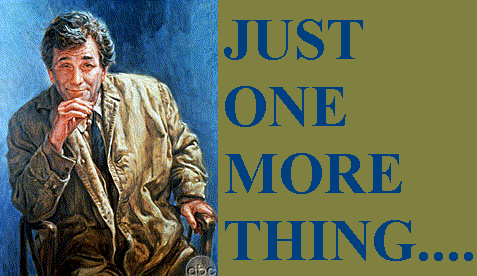
There will be a small prize for those who guess all four correctly without any fancy-doodle internet searching (the pictures are suggestive, not necessarily indicative of the author)!

Tuesday, July 25, 2006

The Prophet

My lonely heart athirst, I trod
A barren waste when, so t'was fated,
a winged serapy 'fore me stood:
Where crossed the desert roads he waited.


Upon my orbs of sightless clay
His fingers lightly he did lay,
And like a startled eagle round me
I gazed and saw the earth surrounded,
Hemmed by sky . . . He touched my ear,
Then t'other, and most marked and clear,
There came to me the gentle flutter
Of angel's wings, I heard the vine
push through the earth and skyward climb,
the deep-sea monsters in the water,
like tiny fishes glide. . . . And o'er
Me calm he bent and out he tore
my sinful tongue . . . not once withdrawing
His gaze from mine, he pushed, unseen
a serpent's deadly sting between
my ice-cold lips . . . Then swiftly drawing
His shining sword, he clove my breast,
Plucked out my quivering heart, and sombre
And grim of aspect, cooly thrust
Into the gaping hole an ember
That ran with flame . . . I lay there, dead
And God, God, spake, and this He said:


"Arise O sage, and my call hearing,
Do as I bid, be naught deterred.
Stride o'er the earth a prophet searing,
The hearts of men with rightoues word."

Aleksandr Pushkin

1826
(translated by Irina Zheleznova)

Friday, July 21, 2006

After Virtue, pt. 1

I've been reading a fascinating book about moral theory from Alasdair MacIntyre called After Virtue. His insights on traditional Western conceptions of ethics and contemporary ethical debate are so tantalizing and thought-provoking that I decided to post a brief series of reflections on what I'm reading. Here's the first:

One of the most common criticisms about Christian morality in the public square is that it is fundamentally sectrian. The accusation of tribalism is probably the most frequently cited evidence of religion's failure to provide ethical norms which can lead humanity out of the intractable moral debates and political tensions in which we find ourselves. Public reason, it is said, must necessarily exclude private religious conviction if there is to be any hope for positive political solutions to issues such as abortion, sexual and racial exclusion, millitary agression, economic imperialism, and the like.

In the first few chapters of MacIntyre's After Virtue it becomes clear that what he calls the "shrill" tone of contemporary moral debate is due to just this kind of tribalism, even after religion has been excluded from the public square. Observing the nature of moral debate easily demonstrates this, as opposing proponents each defend their positions with equally valid arguments based on differing values. Once the arguments are forced back to the expression of these values, such as in the case of abortion which pits "individual freedom" against "protection of the innocent" or "the principle of unviersalizability" (you do not wish that your mother should have had an abortion, therefore you cannnot allow this in the case of others), one has no rational criteria to choose one over the other. This, in turn, results in the fundamentally non-rational, arbitrary choice of personal conviction which is ultimately commended as public policy. Thus the secular landscape is no more plagued with tribalism than religious spheres of moral debate, and the facade of moral reasoning covers what amounts to personal preference.

MacIntyre gives historical reasons for this situation in recounting Kant's refutation of Hume's grounding of morality in desires rather than in reason. Kierkegaard then went beyond both Hume and Kant in rejecting both reason and passion as the ground for morality, opting instead for radical, criterionless choice. The respective failures of each view resulted in the marginalization of philosophical ethics and rational justification in the public square, hence the environment of moral relativism which dominates our culture.

This discussion is leading up to MacIntyre's account of the failure of the Enlightenment and the modern project to provide rational grounds for moral justification - but even at this point the implications of his argument are startling. It extends a problem which is typically characterized as a religious one - namely, how should believers participate in making public policy for those who don't share their beliefs - to the secular kingdoms of this world. On what grounds can anyone justify their public policy recommendations? If it can't be "reason" or "rationality", what's left of secular resources to answer the question?

Wednesday, July 12, 2006

Here Comes the Judge . . .

In 1 Corinthians 4:3-5 Paul says, "But to me it is a very small thing that I may be examined by you, or by any human court; in fact, I do not even examine myself. 4 For I am conscious of nothing against myself, yet I am not by this acquitted; but the one who examines me is the Lord. 5 Therefore do not go on passing judgment before the time, but wait until the Lord comes who will both bring to light the things hidden in the darkness and disclose the motives of men’s hearts; and then each man’s praise will come to him from God.”

Some form of the word " judgment" appears 4 times in these three verses (although the word really has more of the idea of investigation than the final banging of a gavel – that’s why the NAS translates it "examine”), which highlights the activity of skeptical, destructive criticism. Another way of reading it might be “It’s a very small thing to me to be cross-examined by you.” I think these verses are particularly noteworthy in the blogosphere, if for no other reason than for just how bold a response it is to those who are acting as judge. It's hard to imagine recommending that someone respond to another believer’s criticisms by saying, “Honestly, your opinion means very little to me – in fact, they mean next to nothing. So anyway . . . thanks!”

Yet that's effectively what Paul did.

In doing that, he was NOT saying: 1) that he doesn’t care about how what he does affects other people. This is the same Paul who wrote those famous words about love (13:1-13) in the same letter he wrote this.2) that Christians can never judge anything about one another. Again, in the very same letter he wrote about people engaging in open, obvious sin, saying “Do you not judge those who are within the church? The implied answer is “yes, you should!” He goes on to rebuke them for not having judges to judge between fellow believers in ch. 6.3) that he has a “the Lord told me” get out of jail free card which exalts his behavior above accountability.

But what he was up against wasn't loving believers holding one another accountable for their sin - it was the same kind of overbearing, finger-pointing, camel-swallowing, gnat-straining, foaming-at-the-mouth, fault-finding false judgment that Jesus rebuked in the Pharisees. Those who have been blogging for long know what this is like, those who don't even know what a blog is should probably just take a moment to thank Jesus right now. If you're unsure about what this looks like, and have a stomach that's a bit too sensitive for checking out some of the fire-and-blogstone for yourself, just take a peek at Matthew 23:1-13. Jesus illustrates the the problem well with those in His own day who were "sitting in the seat of Moses", "tying up heavy loads" to lay upon people without "lifting a finger" to help, and in all other ways barring people from the kingdom of heaven.

However the Corinthians were evaluating Paul, we know that their determinations of the value of his ministry (and their arrogant assumptions about God's evaluation of it) didn't mean much to him because, as 1 Co. 4:1-2 said, he's Christ's slave, not theirs. It’s only on the “day of the Lord” that these things will be made known, and the Corinthians will be standing next to him, not over him.

But Paul wasn’t just saying that the Corinthians had no right to judge these things – look again at verse 3: he said that even he HIMSELF had no right to judge. That’s a profound thing to think about. God is judge not just because it’s His sovereign right and not yours (even though that’s true), but because He’s the only One wise enough to do it. So it’s not just that you shouldn’t judge other slaves of Christ, you should realize that you CAN’T really judge them – you can’t even judge yourself!

In 1734, during Jonathan Edwards' pastorate in Northampton, somewhere close to 300 people came to Christ – men, women and even children. Edwards said that “some came some weeping with sorrow and distress, others with joy and love, others with pity and concern for the souls of their neighbors.” In writing about what he experienced in his ministry, leading these people and discipling them, he said this:
I know there is a great aptness in men who suppose they have had some experience of the power of religion, to think themselves sufficient to discern and determine the state of others by a little conversation with them; and experience has taught me that this is an error. I once did not imagine that the heart of man had been so unsearchable as it is. I am less charitable, and less uncharitable than once I was. I find more doings in wicked men that may counterfeit, and make a fair show of piety; and more ways that the remaining corruption of the godly may make them appear like carnal men, formalists, and dead hypocrites, than once I knew of. The longer I live, the less I wonder that God challenges it as his prerogative to try the hearts of the children of men, and directs that this business should be let alone till harvest. I desire to adore the wisdom of God, and his goodness to me and my fellow–creatures that he has not committed this great business into the hands of such a poor, weak, and dimsighted creature; one of so much blindness, pride, partiality, prejudice, and deceitfulness of heart; but has committed it into the hands of one infinitely fitter for it, and has made it his prerogative.
Those who others regard as "mature, godly and discerning” are often the ones who turn out to be hypocrites. And those who appear “weak, immature and gullible” are often the ones who grow in grace beyond everyone’s expectations. Edwards came to learn that “victorious Christian living” really is ultimately all about keeping your eyes on your own work, being faithful in your own service, with the earnest desire that it will please your Lord, to whom you will give an account when He returns. And that means you shouldn't necessarily care for the "authoritative" praises or condemnations of other insignificant slaves, even if they have dressed themselves up as popes, and they certainly aren’t out to get their master’s job as Lord and Judge. God help us to be faithful slaves.

Friday, June 30, 2006

Victory in Jesus?

Here's a poignant statement about the weakness of sinners who Christ came to save. Being a minister myself, it's hard not to read the story discussed there and be deeply disturbed.

Christian culture encourages us to actively hide our foolishness because we’re the ones that are supposed to have all the answers. It makes us experts at covering up our own weaknesses so that other Christians will think we’re strong and unbelievers will know that we’re not sinners, like they are. And that, my friends, is an affront to the cross. When we do everything possible to convince both ourselves and others that we’re really decent, prudent, mature Christians who’ve basically got it all together, the inevitable result is that we not only not only reject God's Holy Spirit, but we deny our ongoing need as sinners for atonement, forgiveness and mediation. When our attempts to be thought strong, wise and noble become habitual, and we've successfully convinced ourselves of our maturity, the eventual result is a marginalizing and ostracizing those who are actually openly weak among us. We create a culture of fear so that openly admitting our weaknesses and foolishness becomes the scariest thing imaginable and appearing impenetrable is a desirable standard of holiness. And maybe our motives are good – we want unbelievers to see that Jesus really has changed us and we want other Christians to know that we really are saved and that we really do know God. But God is brutally honest about the fruit of wanting to be considered wise, strong and noble by others; and that fruit is precisely the mess we read about in stories like the one linked above. May He have mercy on us while we struggle to come to terms with the depth of our sin and the lying standards of perfection which so often nullify God's grace in Jesus.

Saturday, June 17, 2006

Ack!

UPDATE (6/22): Apparently Brandon Witherow, a Ph.D candidate at Westminster Seminary has been following the accusations of lubricious heresy hunters surrounding Enns' book. Both his reactions to the exchange chronicled below as well the links to previous discussions of the book are worth checking out.

UPDATE (6/18):
Steve has since posted a few new comments which both persist in missing my point and ironically label me as "angry" - I'd be happy to respond in more detail to anyone who's interested - just post a comment here; but judging from the level of vitriol gushing from his responses, and an apparent preference for "sniping" rather than talking, responding any further seems pointless. iMonk has posted some reactions to the venom which, in Steve's zeal, splashed onto him from the response to me.

That's one of the noises one makes when gurgling in his own blood, which was a metaphorical posture I took while reading Steve Hays eviscerate a few of my last posts. Steve kindly refers to me as talented, for which I'm genuinely flattered. It gets a bit ugly from there, though, as I'm subsequently referred to as cocky, juvenile and immature (which, of course, I am from time to time). Most of what motivates the (dare I say) overly harsh critique, it seems, were my comments about Don Carson (which, at second glance did come off as far snootier than I had intended). In any case, it clearly pricked a nerve, and I'm sorry.

But I hadn't intended anything like what Steve fears I meant - namely that Carson is somehow "out of touch". The point I was making, in fact, depends very much on the opposite evaluation. That point, again, is that many students within conservative evangelical circles have been nurtured on the very over-simplifications, glib harmonizations and anachronisms that Enns is addressing. Carson may take much of what Enns says as "obvious" and "unnecessary" and "less than ground-breaking", pointing to nuances that many scholars commonly accept when it comes to issues like ANE parallels and cultural situatedness in Scripture - but this book wasn't written for them. That's why the bibliographies offered by Steve in his vigorous response to my comments are helpful, but completely irrelevant.

The helpfulness of the book is its honest presentation of the challenges presented by the Old Testament - a presentation that may linger irritatingly for OT scholars to whom the issues are old hat (and to a more educated audience like Steve, who are anxious to rush to their preferred answers to long-known questions). But for new students who are newly coming to grips with these glaringly terrestrial marks of Scripture, it is an exceedingly wise introduction because it takes their context seriously - namely that of the raging Bible wars between liberals and conservatives, marked by a posture of defense in conservative evangelical churches. The "doceticism" described by Enns in relation to the Bible is, in my judgment, a wise strategy for acknowledging the popular emphasis on Scripture's heavenly origin over against marks of its human composition. That - not an attempt to present a comprehensive theological (or hermeneutical) model for understanding Scripture - is the goal of this book. That's also why Carson's desire for a more detailed exposition of the incarnation analogy misses the point. Again, my criticism wasn't that Carson is an idiot - it's the opposite. He's an impressively credentialed biblical scholar. But this book wasn't written to whet his academic appetite, it was written to deal with what can be a crisis for students who have consistently heard only one side of the story.

It's important to point out that this was really my main criticism of both Carson and Helm. You'll see that at the end of my comments I noted that I felt both of their criticisms, cautions and suggestions weren't inappropriate. Neither my review, nor the book, implies that there haven't been real attempts to solve the kind of universally acknowledged theological and hermeneutical difficulties which Enns discusses, that Enns is somehow dealing with issues no one has ever dealt with before, or that conservatives have somehow "locked away evidence". You'll not find any of those sentiments in my review, and Steve's recitation of well-known books and authors don't refute claims that I never made. Neither did I claim that these men were oblivious to the various debates and difficulties in the OT, or that Enns was particularly ground-breaking in his approach to the difficulties. What I did say, and am still saying, is that Enns is to be commended for knowing his audience - he's not a Tubingen liberal speaking to an academic audience. He's a Reformed, conservative evangelical speaking to conservative evangelical students. He realizes (in a way that I think Carson didn't take into account) that he's not talking to "Arians", but to many who have been gorged to excess on apologetic discourses on the timeless, enduring, and heavenly qualities of the Bible and, when confronted with its cultural moorings, are coming to a point of crisis. Characterizing such a demographic as "angry young men" both illustrates and exacerbates the problem Enns is trying to address.

There's more to say, especially about Steve's suggestions about apostolic exegesis (and perhaps about Enns repeated assertions that demonstrate his unwillingness to admit of "errors"), and perhaps I'll do that later. But I should probably end my explanation with a reminder about the mode of communication being utilized here. Blogs, for me, anyway, are somewhere in between an email and an essay, both in their manner of expression and their content. Like an email they are often informal codifications of a person's thoughts, and aren't meant to be taken with the precision of a serious publication. So while they bear certain marks of an essay, with argumentation, critical reflection and even a certain polemical edge, they shouldn't be taken as final pronouncements as much as an invitation for discussion. More importantly, like email, they're not very good reflections of what a person is really like. Steve seems to take me for an unfortunate blend of talent and egomania. I fear that this appraisal may come from taking me even more seriously than he's convinced I take myself. His apparent distaste for my presence at the Boar's Head Tavern, for instance, seems to assume that its very much like a denominational association of some kind rather than an attempt to meet new people, make new friends, and talk about areas of interest. After feeling thoroughly clobbered by his comments it did me some good to remember the potential for distortion refracted by what bloggers write during a few minutes of distraction from the rest of their busy lives.

Thursday, June 15, 2006

Who Knew . . .

You scored as Karl Barth. The daddy of 20th Century theology. You perceive liberal theology to be a disaster and so you insist that the revelation of Christ, not human experience, should be the starting point for all theology.

Karl Barth


80%

John Calvin


73%

Friedrich Schleiermacher


67%

J?Moltmann


67%

Anselm


60%

Paul Tillich


60%

Charles Finney


60%

Augustine


53%

Jonathan Edwards


47%

Martin Luther


40%

Which theologian are you?
created with QuizFarm.com

Tuesday, June 13, 2006

"Enns-piration" pt. 2

Last week I gave a brief plug for Peter Enns’ Inspiration and Incarnation: Evangelicals and the Problem of the Old Testament, saying that it provided an essential dimension to the doctrine of inerrancy. His basic thesis is that Biblical revelation comes in the form of enculturated human expression, and that affirming the humanity of Scripture doesn’t negate it’s divine origin – it actually affirms it, because it follows the pattern of Jesus’ own divinity as the incarnate God.

Enns isn’t the first to suggest the incarnation as a theoretical model in which to understand Scripture, but his articulation of it does put him at odds with certain sectors of his own tradition. The book has drawn some criticism, in part from those who remain puzzled that more people aren’t aware of Gleason Archer’s definitive resolution of these issues years ago. Others simply dismiss it on the grounds that the Westminster confession never envisioned the proposal. But it’s also drawn criticism from more notable evangelical stalwarts. In his review, Paul Helm, Emeritus professor of philosophy at the University of London, called the book a superficial theological and epistemological “failure”. Don Carson, in a tripartite review, criticized the book for giving more space to fighting the “docetist” (i.e. the over-emphasis on the divine) than to fighting the Arian (i.e. the over-emphasis on the human). In the end he finds Enns to be decidedly “non-pastoral”. Unfortunately (and ironically) the criticisms are more troubling than anything in the book, because they fail to take seriously both the audience and the pastoral problems which Enns is addressing.

I’m not sure which churches Don Carson has attended in his lifetime, but from the sound of it they are highly sophisticated, gingerly nuanced and impressively level-headed pulpits. Either this is a pleasantly uncanny experience or an intentionally blind optimism. In either case, with statements like “Most of us glory in the fact that God has disclosed himself to us in space-time history, in real words, to real people, in real languages” and “[ANE parallels] should cause no surprise among those who fully recognize how much the biblical revelation is grounded in history” one wonders if Carson has ever been to an average conservative church meeting in his entire life. One of my Sunday school attendees was shocked and horrified at a remark that Jesus’ teaching sprung from His study of the Law and the Prophets, declaring that He didn’t need to “study” because He was God and His teaching was a “direct revelation from God”! A few families left a neighboring church because of their outrage at the preacher’s suggestion that Paul was in any way affected by his surrounding culture.

The fact is that evangelical pulpits typically ram an apologetic agenda through the text of the Old Testament to the degree that the text becomes a side-issue. Maybe I’m in the backwoods of conservative evangelicalism, but I’ve never heard a sermon in Genesis that didn’t comprise your basic “creation vs. evolution” seminar. I’ve never heard about ANE parallels and similarities to ANYTHING in the Law (much less the creation story) coming from the pulpit. Moreover, I’ve never, not once, heard the call to honor the Scripture’s diversity coming from my Sunday School class, and the models for resolving “apparent conflicts” which were held out to me have consistently been the voices of steam-rolling harmonization. What both Carson and Helm seem to miss is that this experience is much more typical than they’d like to admit, and the failure for evangelical scholars to admit it is one of the chief reasons doubt arises in the hearts of young students who have been nourished on the very over-simplifications and polarizations Enns is seeking to correct. In other words, where Carson wants scholarly nuance and fine-tuning in Enns’ characterizations are precisely the points at which most haven’t ever heard such nuance and fine-tuning. And that’s the point of this book. Many of those who would reject the tenents of this book would be equally queasy about the Longman book Carson recommends instead. Though Carson’s first criticism is that Enns doesn’t really understand his audience, the shoe appears to be on the other foot – it’s Carson who doesn’t seem to understand the dissatisfaction of disaffected students who are looking for evangelical scholars to recognize the polarized messages they’re actually hearing in their pulpits and classrooms (a longing he labels “the angry young man syndrome”).

Likewise Helm, who states in the opening lines of his review: “[Enns] writes about the identity and purpose of the Bible by concentrating on the difficulties of interpreting some Old Testament data. This should immediately arouse our suspicions.” Such a statement will provide little comfort for those who are tired of having theological glaze poured over what seem to be real difficulties in actually interpreting the text (the place where we’re supposed to get our theology) - in other words, the audience of this book. It’s no surprise, therefore, to hear these criticisms coming from two systematic theologians. Both Helm and Carson interpret the book as giving “priority” to the human marks of Scripture (which is really the source of Carson’s complaint that “too little time is given to the doctrine of incarnation”; i.e. too little time spent on the divinity side of the analogy) – but such a criticism demonstrates a studied blindness toward exactly where the pendulum actually is in conservative churches today. In their continued fight against encroaching liberalism conservative evangelicals aren't struggling with Arian tendencies – they’re struggling with docetic ones. Perhaps fighting rabid docetism isn’t best suited to the strategy of giving “equal time” to fighting Arianism. Regardless of such a judgment, though, neither Carson nor Helm ever present what an alternative to Enns’ proposal might actually mean. Surely the CONTENT of what is gained in the process of interpretation is the divine Word of God; and certainly the PROCESS of enscripturation is divinely ordered – but in what sense is the mode of expression “divine”? The authors were “born along by the Spirit”, but what “heavenly” qualities should we expect to find in the actual words of Scripture? For all the protest against Enns’ supposed “interpretive naiveté” in regard to Arianism, beyond giving attention to the cultural, historical, and linguistic temporalities of the text, I’m not sure what else is an interpreter is to do.

Enns book really seeks to stimulate the imagination as to how the Bible can be a product of human culture and still be the divine Word of God. His answers are meant to be suggestive, not comprehensive, and though Carson states his criticisms as not “to ask Enns to write an entirely different book”, that, in the end, are what his criticisms amount to. Helm’s review falters under a grosser failure, namely the refusal to reckon with the core of Enns’ vision, which will resonate in the minds of many students – namely that the actual phenomena of Scripture (not merely Scriptural affirmations of its reliability) should be at the bottom floor in formulating our understanding of how Scripture works. Instead, he simply states that “he starts at the wrong end”. That accusation misses the point not only because starting with the phenomena of Scripture IS HIS PROPOSAL, but also because of the degree to which apologetics has defined the agenda in conservative sectors of OT studies, and have fueled the very excesses the book seeks to curb. Both Carson and Helm glibly bypass the most difficult examples of diversity within the OT canon, Carson by offering his own potential harmonization of the less significant examples and Helm by skipping the actual data altogether (how Helm can accuse him of “fideism” and at the same time recommend “staring from dogma instead of difficulties” is beyond me). For these reasons, and a few more from which I will spare you, I believe Inspiration and Incarnation stands up under scrutiny; not because the criticisms are devoid of useful critiques, appropriate cautions or valid suggestions, but because Enns' words, like apples of gold in settings of silver, are provocatively delivered in exactly the right circumstances.

Saturday, June 10, 2006

Evy said "No"


I just shaved recently and upon walking out of the watercloset Evy suddenly began violently gagging and swallowing. I can't imagine why.

Posted by Picasa

Monday, June 05, 2006

"Enns-piration"

I recently finished Peter Enns’ brief introduction to the difficulties of an evangelical doctrine of Scripture presented by the Old Testament. The book is called Inspiration and Incarnation, and as has been pointed out by others, it’s an important read for inerrantists such as myself.

Enns’ basic thesis is that a doctrine of Scripture should arise from the Scriptures themselves. Well, duh. But as you might expect, that recommendation turns out to be much more controversial than it initially sounds, because Enns is concerned not only about conforming our doctrine of Scripture to the Biblical testimony of its authority but to the phenomena of Scripture itself – with all its cultural moorings, rich diversity and strange uses of previous texts. These three issues only become problems in need of creative explanation if one develops expectations of Scripture from outside Scripture – which is precisely Enns’ critique of modern notions of inspiration. The result of such modern formulations is that interpretation becomes an exercise in a rather shifty brand of apologetics – ANE parallels are completely ignored in order to make the Bible appear culturally timeless; texts with genuinely different perspectives are forcibly crammed into a homogenized goo in order to make the Bible appear seamlessly harmonized; the hopelessly unscientific method with which Scripture uses Scripture is either dressed up as historical-grammatical exegesis or unconvincingly privileged as a non-repeatable apostolic privilege – all from a desire to rid the Bible from any signs of being a genuinely human (as well as divine) production.

The answer to such distortion, says Enns, is to see the written Word of God functioning according to the same nature as the incarnate Word of God – a perfect symbiosis of humanity and divinity. Jesus perfectly revealed the Father not as a hovering wraith or Docetic illusion, but as a genuine 1st C. Jewish man. He spoke the language, lived and participated within ancient Palestinian culture, and displayed all of the creaturely dependence requisite to humanity. He wasn’t a god just pretending to be a man, as so many seem to believe (and then wonder why they’re not moved by the stories of suffering and crucifixion in the Gospels). He was God anchored in time, culture and finite dependence upon the Father. The written Word of God should be understood as revealing the Father in the same way. As evangelicals continue to thrash about over theories of inspiration, some are drowning and others are barely treading water while the actual content of the Bible – in all of its varied and richly enculturated glory – circles the drain. In the next week or so, as I have time, I’ll be posting an evaluation of some of the criticisms I’ve read (from the likes of such Reformed luminaries as Paul Helm). In the meantime, Inspiration and Incarnation: Evangelicals and the Problem of the Old Testament is required reading.

Thursday, June 01, 2006

The Blue Raja at the BHT

I'll probably still make the odd post here, too.


I know. Shut up.

Friday, March 24, 2006

This is Getting Obnoxious . . .

I feel like I'm having my 3rd "going out of business" sale this week - but dramatic exits aside, I did want to follow up my exit with a brief explanation. You'll notice that I didn't offer one initially - I should have kn0wn better. My church experiences over the last few years has been a poignant reminder that a vacuum of explanation will always be filled by spurious data - controversy is always more fun than reality.

I'm not throwing in the turban because I'm as sensitive as some might believe me to be - I have ample chest hair, and a stunning capacity for dead-lifting heavy objects. All that to say I would hate for you to imagine me slumped over my keyboard, crying like Gidget on a date gone wrong at my poor reception in the blogosphere. I've been warmly welcomed and respectfully recieved by most.

I would also hate for anyone to imagine that I'm selling the silverware over various rhetorical scuffles on PyroManiacs. I do have to admit, however, that it's not long before my presence in the meta renews old frustrations - but I'm never under the illusion that I'm not asking for it. I know what I'm going to hear before I go over there, and yet I persist, to their puzzlement and sometimes mine. Am I just looking for attention, or do I really think that they'll reverse some of the strongest and dearest convictions they hold in life? Although I can't say that I ever enjoy the often curt, sometimes dissmissive and usually immediate evaluations of my comments (as though they were simply my "answers" waiting to be checked by their "answer key"), my real reasons for showing up aren't spoken often enough - I really do love most of what I read there. I happen to find insatiable delight in the exaltation of God's sovereign majesty. As often as I am frustrated by various disagreements, I am pleasantly surprised by posts which don't fit the caricature of the Reformed Baptist obsession with doctrine for doctrine's sake (such as James' recent post on the Messiah and Justice - actually pretty much everything James says, some of Frank Turk's stuff on missions and Phil's interaction with Michael Spencer in the comments to this post). Some trusted friends have told me to stay away - but I can't. I agree with so much (let God be my judge!) that I long for genuine interaction on the points with which I don't agree. I'm sure that there are a few patrons of the Pyros who would sneer at that, but I've recieved the strangest (and kindest!) emails from those who foolishly fuel the hope of that possibility (which is hindered every bit as much by me as it is Phil Johnson)!

But, that brings me to the real reason for my limey fork-flinging to come to an end - I answered someone who asked if it was the way I was being treated by Phil and Tim Bayly that "broke the camels back" (I feel like throwing in a "as it were" somewhere around here, just for Tim). I answered "yes and no". Hopefully the above can help to fill in the "no" a little. But, now for the "yes": I started blogging because I like to read - not Sweet Valley High, not The Grapes of Wrath, not The Prayer of Jabez, and God help me, not even the better devotional literature - I like to read books which are directly related to the personal discovery of Bible study: books on method - theological, hermeneutical, ethical, historical and grammatical. It's my only real hobby. That's not something to brag about, either - I've heard Solomon's warning (Ec. 12:12) and I believe in its wisdom. I'll not bore anyone trying to convince them that it's my love for the treasure I have in Scripture that fuels my desire in this way; and I'll certainly not waste any time trying not to sound pedantic or self-important (too late). Let's just say that "academic respectability" isn't really something I'm all that worried about in a small church where most of my constituents could care less about "variegated nomism". I'm painfully aware that 1) it's not like I've read bags of academic books 2) that sort of interest is one very small part of the Christian life 3) I've not necessarily understood a single thing I've read - but that's where the blog was supposed to come in. I wanted a forum to log my thoughts and recieve feedback with a view toward processing what happens to strike me in the reading. And all of that, of course, was with a view toward growing in my ability to understand and apply Scripture.

Yet, after about a year on the blogosphere I've discovered something (partially through PyroManiacs, but elsewhere as well): being in process is something you're not really allowed to do in public when it comes to theology - at least not in the theo-blogging community. My church family allows me the room to grow in my leadership skills, my preaching, my marriage, my parenting and any number of sanctification issues. Growth in these areas take both time and experience. You can't simulate it by repeating someone else's preaching style, mimicking someone else's relationships, carbon-copying someone else's parenting techniques, etc. But when it comes to theological stimulation on the internet, it seems as though the growth is expected to take place all at once. Very few bloggers allow people to "work through" theological convictions without enormous suspicion. When you are handed a particular set of convictions and told that it is the truth, you may, if you're lucky, be told how such a person arrived at it. But once you attempt to get there yourself, by the power of your own conviction (asking questions and challenging what sounds funny) it's assumed that you are aiding (if not identifying yourself with) the enemies of the truth. It's as though someone were snapping their fingers saying, "Have a perfect marriage - NOW!!!" and then accusing you of rebellion for not complying immediately.

Please hear me right there - I'm not talking about trying to re-invent the foundational truths expressed in the earliest creeds and consensus, or the plainest saving truths about the Gospel - but in trying to evaluate the theological proposals of other Christians according to Scripture, and in trying to reexamine my own theology according to the Scriptures, I'm realizing that what people want to see isn't that you're INTERESTED in the answer, or that you're wrestling with Scripture in COMING to the answer, it's that you HAVE IT ALREADY. The general lack of willingness to let you get there, or patiently walk with you in the process makes this whole exercise seem like more of a loss than a win for me, and it felt like time to cut my losses.

The fear of relativism (which may in fact be one of the most deplorable evils of our time) seems to result in impatient frustration with Christians who question them about their interpretations or theological convictions. More than that, the moment a person stops to ask (in faith!) "have I missed something that the Scriptures teach about justification or the Gospel?" its bemoaned that the postmodernists have won. The question itself is viewed as a fickle willingness to forsake the Gospel instead of a faithful desire to hear God and not ourselves in Scripture. And that strikes at the core of what it means for me to believe in the Bible's authority - namely that in my study it always maintains the right to say I'm wrong.

The fact is that I know what I believe - but I want the Scriptures to have the authority to scrutinize my beliefs in practice, not just in theory (as do many of those with whom I disagree). Sadly, I genuinely don't know how to demonstrate that on the blogosphere without alienating those whose theology happens to be the most like mine. It just seems like more grief than it's worth. Anyway, hopefully that helps to explain the departure. Thanks again for your well-wishing.


It wasn't very well thought out, it certainly wasn't carefully edited - but it's REALLY the last one.


Really.

Thursday, March 23, 2006

Stick a Fork in Me, I'm Done!

If you need me, I'll be pawning your mom's silverware . . .

Friday, March 17, 2006

. . . but I didn't write it. It comes from Mike Bird, who has some great stuff to say, as usual. Here's a post he did recently about why he's neither a fundamentalist nor a liberal. Found myself saying 'amen', so I thought I'd re-post it here for your encouragement. If you decide to leave feedback, do comment on his site as well!
-----------------------------------------------------------------------
Fundamentalist versus Liberal

In light of the recent posts by Ben Myers and Chris Tilling I thought I'd add my own thoughts.

Preliminary Remarks

1. Most persons who use the term "fundamentalist" pejoratively are simply ignorant of the historical circumstances surrounding the origins of fundamentalism as a theological movement in North America in the early 20th century. Many are also ill informed about the historical, theological and cultural differences between Fundamentalism and Evangelicalism - the two cannot be equated.

2. The terms "fundamentalist" and "liberal" are often used these days as an opprobrium but they have also become relative terms, i.e. a fundamentalist is someone more conservative than me and a liberal is someone less conservative than me. (I've been called both!) To make things worse, Old Liberalism was a package and you could easily discover an Old Liberal based on certain questions, e.g. virgin birth, inerrancy, resurrection, atonement, etc. But today there are a number of theologians who don't quite fit the bill, e.g. Rowan Williams. William's has an orthodox view of the resurrection (as far as I can tell), but his views of sexuality are as liberal as Hillary Clinton speaking at an ACLU convention. In sum, other than being an insult, the terms fundamentalist and liberal don't really mean much anymore.

3. The Fundamentalis vesus Liberal controversy was really a symptom of Christianity wrestling with the challenges posed by modernity. There were two reactions to modernity: "run for the hills and hide your daughters" (Fundamentalists) or "wine me and dine me" (Liberals). As we enter into a Postmodern period the liberal versus fundametnalist controversy is no longer the defining issue for Western Christianity.

See further:

- Carl F. Henry, The Uneasy Conscience of Modern Fundamentalism (1947)
- George Marsden, Fundamentalism and American Culture (1980)

Why I'm not a Fundamentalist

1. Fundamentalists major on the minors, and make minor issues tests for faith and orthodoxy (e.g. alchol, Bible translations, etc).

2. Fundamentalists fail to distinguish between what is Christian and what is the cultural Christianity that they were nurtured on.

3. Fundamentalists fail to distinguishy between areas of conviction and areas of command, and treat areas of conscience as a test of orthodoxy.

4. Fundamentalists have a view of Scripture that is docetic in that Scripture is divine but it is not human - no human processes (e.g. the Synoptic problem) are compatible with divine authorship.

5. Fundamentalists preach the authority of the text but practice the authority of the community.

6. Fundamentalists fails to appreciate the different genres of the Bible or comprehend the role of presuppositions in influencing our reading of Scripture.

7. Fundamentalists believe in theological cloning rather than theological learning.

8. Fundamentalists fail to be the salt of the earth as they are concerned almost exclusively with the minutia of doctrinal purity and correctness.

9. Fundamentalists have a lopsided soteriology as they think of salvation as purely the salvation of souls for heaven rather than the liberation of persons from sin, sickness, subjugation, and death. They aim for decisions rather than making disciples.

10. Fundamentalists fail to recognize the true marks of the Church and allow for a diversity of voices within the body of Christ.

11. Fundamentalists are more excited about what they are against, than what they are for.

12. Fundamentalists regard the Spirit as a theological entity, but not as a presence that manifests itself in worship or loving community.

Why I'm Not a Liberal

1. Liberals mimic culture to the point that they simply imitate the contemporary values of the day and wrap them up in some Christian wrapping paper. The world looks on and says, "Thanks for affirming all of my values but you can keep the wrapping paper".

2. Liberals minor on the majors - sin, atonement, and resurrection.

3. Liberals have a view of Scripture that is Arrian - it is human but not divine.

4. Liberals take Scripture to be illustrative but not necessarily prescriptive and normative for faith and praxis.

5. Liberals deny the transforming power of the gospel to liberate persons from every form of sin.

6. Liberals minimize the unique revelation of God in Christ and deny the eschatological finality of Jesus Christ.

7. The Gospel of Liberalism was what Karl Rahner warned us of: A God without wrath takes men without sin to a kingdom without judgment.

8. Liberals de-historize and de-apocalypticize the message of the Prophets, Jesus and the Apostles.

9. Liberals preach pluralism but do not tolerate anyone who fails to embrace their pluralistic ethos.

10. Liberals believe the Spirit is a Spirit of unity but not a Spirit of truth.

11. Liberals think that the only heresy is to believe in heresy.

12. Liberals think that the church is about programs and structures, when it is about creating gospel-proclaiming, Spirit-drive, Christ-centred, God-focused redemptive communities.

Tuesday, March 14, 2006

Macular Degeneration

I hate to admit it, but I'm petering out. I'm staring at a screen for sermon prep and Bible Study creation all week long, and the thought of going home to blog makes my eyes want to vomit. By the end of the week they feel like Gandalf's description of the eye of Sauron - "wreathed in flame and lidless". Good luck getting Visine to work on that. But more than that, there's so much to comment upon and so little time to attend to it that I've finally decided to give blogging a break for a bit, at least until I've hit a stride with some of my other responsibilities. I know I'll be back soon, though, if for no other reason than that my brief absence from the blogosphere has already saddled my conscience with an unbearable pressure to sit down and spray text about a million different topics - James Crossley's post about secularism in Biblical Studies, Adrian Warnock's comments on the interchange between iMonk and Phil Johnson (and iMonk's fantastic follow up post), common confusion about propositions, modernism and the Enlightenment (scroll down to the end of the page), my brother's acceptance into Princeton, Michael Bird's excellent upcoming article in Tyndale Bulletin, evaluations of some competing proposals for the ecumenical task, exciting developments in Bible Software and of course, brief blurts about the books I'm currently reading (especially Francis Watson's Paul and the Hermeneutics of Faith and Alasdair Macintyre's After Virtue). I'm sometimes seized with a kind of catatonic schizophrenia in the middle of a conversation while thinking about something I'd like to write, but I never seem to find the time to successfully log them in at Soylent Green; I'm tired of saved half-drafts that I just delete in frustration at not having enough time to finish them.

But the catharsis will have to wait until at least mid-April when the house we're building is completed and I've moved out of my gracious mother-in-law's home. In the meantime, I hope you'll not forget about me!

And now, for a moment of complete non-sequitur - I've tried to find a reason to post pictures of my family for some time now, but wasn't able to generate one that didn't sound like an entry from my diary. So, for absolutely no reason at all, here they are: My wife and I, my daughter Madelyne, my son Sameer and my youngest, Raj.


Thursday, March 02, 2006

The Faithful Forgiveness of God

The pixelated beauty to my immediate left is a chap named Timothy Gombis, who currently teaches Bible at Cedarville University in Ohio. Though I know that a few other blogs (not least Metalepsis) have already posted the following meditation on their own sites, I thought it was worth reproducing here as well. Tim's a good friend and a great guy who could easily bench press a car of your choosing with both of our mothers sitting in it. Keep that in mind if you have any comments.
-------------------------------------------------------------------
Our texts for this week reveal to us the logic of God's forgiveness. They also reveal to us our own ways with forgiveness and perhaps why we have such a hard time coming to grips with God's outrageous grace. These texts serve as a pleasant and stunning surprise, a blessed rebuke.

We foolishly think that we have God all figured out, don't we? We think that we know how He deals with sinners, what He's like, how He thinks. What is God like? Well, He's mostly like us, except totally huge, and He knows everything. And He told us what is right and wrong, so if we choose to do wrong, He'll be rightly outraged at us - because He told us not to do it, and we should've known better.

But, thankfully, He has made a way for us to be forgiven, and if we're willing to clean up our act, make things right, He's willing to consider taking us back. But He'll keep His eye on us, and if we blow it again..., well, we might want to read the fine print in our contract.

We may not lay out our understanding of God so explicitly, but we often feel that this is what God is like, right? He's very huge and powerful, and his heart isn't as small as that of the Grinch who stole Christmas - whose heart was two sizes too small - but surely it's not THAT big - after all, there's gotta be some limit to forgiveness and grace.

In thinking about God in this way, we have managed to become complete idolaters; we have made God in our own image. What is He like? What's His forgiveness like? Probably like ours.
Scripture, however, turns this idolatry on its head, giving us a true glimpse into the ways of God with His people. We will discover what these texts tell us about the forgiveness of God by asking and answering three questions.

First, why does God forgive sins? Because this is who He is! It is His identity, according to the final verse in our Isaiah passage: "I, I am He who blots out your transgressions for my own sake, and I will not remember your sins." It is who God is, it is what He does - it's His calling card; He forgives sins!

And He loves to forgive! Our Isaiah text depicts God going to great lengths to overcome our sin and to arrange situations in such a way so that we might more effectively enjoy His love. In fact, what makes God angry in the Isaiah passage, is that Israel refused to give God opportunities to forgive. "Yet you did not call upon me, O Jacob; but you have been weary of me, O Israel!"

So God forgives because it is his very nature to do so - and he DELIGHTS to forgive sinners.
These texts force us to ask a second question: Is this really so? How can we be sure about this? Does he really love to forgive, or does He do it dragging His feet? When God forgives sins, does he do it while rolling his eyes?

And we want to know, because this is how WE forgive, isn't it? "Well, I know I'm supposed to forgive you, so I guess I do. But I don't have to like it!! And I don't have to like you!! I'm still angry for what you've done to me, so you need to spend a few more days in the doghouse until you get completely back in my favor."

And we think that by holding on to bitterness against those who have wronged us we're only showing proper righteous anger at sin. "It's a godly anger at sin, alright?!"

So, in the somewhat mystifying words of the 2 Corinthians text, our forgiveness is "yes and no." We do, but we don't... We forgive..., but we'll just see how things go.

But God is completely unlike us - He is faithful and His word is NOT "yes and no," but YES!!
How do we know it's "yes" and not "yes and no?"

Look at Jesus!! Listen to how outrageous this is - God Himself came into the world, fully participated in the broken human condition, and died. And God raised Jesus from the dead to confirm His promises - to show that he is SERIOUS about forgiveness, SERIOUS about redemption and restoration.

God is fully committed to us - He is not of two minds!! He is not mostly committed to us, but we'll see how things go.

Jesus is the YES of God to us. There is no indecision with God toward his people.
"In Jesus it is always 'Yes.' For in him every one of God's promises is a 'yes.' For this reason it is through Jesus that we say the 'Amen', to the glory of God."

And this is gospel - this is good news, because we know ourselves. We know our sinful hearts, and it is so easy to believe the lie that it's a long road back to God's good graces. It's hard work getting back into his favor. But this is only true if God is like us - thanks be to God that He is not.
The third question that these texts raise and answer is; What must be done to obtain forgiveness?

This is answered in several ways in these Scripture passages, but I love how the Gospel reading answers it - especially when we think about how we usually read these gospel texts.

We typically read this scene where Jesus heals the man lowered through the roof in such an unreal manner. The guys run their friend up to the roof on a stretcher, remove a skylight, install a system of pulleys to the roof and smoothly lower him down - and, of course, he's reclining comfortably - and plop him nicely down in front of Jesus who then conducts this interchange with him and the scribes, to the quiet approval of all those watching, who close the scene with the polite applause of spectators at a golf tournament.

This is, of course, pure fantasy. Think about this scene. It's from Mark, a very gritty Gospel - full of action and pulsing with tension. These men hear that Jesus is at home, so they grab their friend and carry him down narrow streets, bumping his head on stone walls as they twist and turn down the alleyways, and arrive at Jesus' house. They're probably all disheveled and their lame friend is very uncomfortable and very likely in great pain, at this point.

"Ugh! The house is crowded, what're we going to do?! Let's go through the roof!"

"What?! Are you crazy?!"

So they drag him up to the roof, tear apart the roof, with stuff falling down all over the people inside, who are probably not at all happy that these strangers are doing a demo-job on Jesus' house - and while Jesus is teaching!

But so what?! We gotta get to Jesus! They lower him down...how?! With what!? We don't know - rope? His clothes? Again, this guy can't be all that comfortable at this point. But, as it happens, there he is, lying on the floor, on his mat.

And then what happens...

Jesus, taking note of their faith, says to the man, "your sins are forgiven."
This story is so familiar to us, we have completely missed how bizarre this is!! Think of all the commotion and the dust and dirt, stuff from the roof falling all over the people down below, people shooting dirty looks up at the guys who just lowered some street person down onto Jesus' IKEA coffee table..., it's crazy!

There is so much going on here, but we must take note of two things:

First, the phrase "when Jesus saw their faith." How often have we read this as, "when Jesus saw their qualifications?" Why did Jesus heal the man, we ask? Because of their great faith - Jesus looked into their hearts and saw that they had great faith!! So we too must have great faith!
NO!! What displayed their faith? Simply this - that they knew they needed something, and that Jesus could help them. That's it. "We're in need, Jesus is near, let's go."

Just like Psalm 32, v. 6: "I confessed my sin, and you forgave the guilt of my sin." That's it - recognition of our sin, forgiveness granted by God. There's no middle step of elaborate performance or credential-checking.

The second thing to note is Jesus' response to witnessing this bizarre instance of breaking and entering that unfolds before him: The dust starts to settle, the people all look at Jesus, He looks at the men, and says to the man, "Son, your sins are forgiven."

No discussion, no questions, no checking of credentials, no theological sparring. No fancy introductory speech, just a total outcast lowered into Jesus' living room, staring dumbfounded at Jesus while he has his sins forgiven by the King of creation.

The lesson here is this: God's hair-trigger response is set to forgive. Call on the Lord, and He will forgive. Intrude on Jesus' personal space, make yourself a nuisance to Jesus, and he'll forgive your sins.

On what basis does God forgive? Recognize your need and call on him and he'll forgive. End of discussion.

God delights to forgive, is angry that his people won't give him opportunities to forgive! God loves to show mercy, so "be glad you righteous, and rejoice in the Lord."

Wednesday, March 01, 2006

Reformed Epistemology and Narrative Theology

SINCE THIS ARTICLE GOT SUCH LITTLE FEEDBACK (being sandwiched between two more "controversial" posts on the Master's Seminary's take on Emergent), I THOUGHT I'D MOVE IT UP HERE AND HOPE IT GETS SOME MORE ATTENTION!

It's been my suspicion as of late that much of what narrative theology has to offer by way of answering the problems of Enlightenment modernism comport well with the presuppositional style of Reformed apologetics. While browsing through my Theological Journal Disc I came across an intriguing article by David Kelly Clark called "Narrative Theology and Apologetics" (Journal of the Evangelical Theological Society, no. 36 (1993): 4). I remember enjoying reading Clark in my apologetics and evangelism class while in seminary.

In this article Clark, a presuppositionalist apologist and Reformed philosopher of religion, described both the promise and the pitfalls of narrative theology. He draws upon the interchange between Hans Frei and Carl F. H. Henry, giving an even-handed appraisal of the benefits of both approaches. After giving considerable time to pointing out the potential problems with narrative approaches (1. the unclear nature of what that might mean, 2. the detachment of narrative approaches from history 3. conceputal realtivism, "too much Wittgenstein") he goes on to say: "Despite all this, narrative theology does have some things right. Evangelical apologists would do well to develop their thought and strategy in light of these themes . . .":

1) Narrative theology focuses on concrete modes of understnading and communication - traditional apologetics are too abstractly philosophical

2) It encourages us to learn how to work in relativistic and pluralistic milleus - narrative can translate biblical truth into postmodern models of rationality without giving in to relativism

3) It highlights how difficult and complex apologetics really is - modernistic apologetics often prove futile in postmodern contexts

4) It promotes a flexible apologetic strategy, one that responds to particular needs in specific situations - Clark says, "The validity of a multiple-perspectives approach at a limited level (though not at the comprehensive level of worldviews) offers the apologist some flexibility in argument even though the goal, an experience with Jesus Christ, remains constant."

5) It allows for more varied sorts of evidence, including religious experiences - shedding straitjackets of foundationalist (evidentialist) critiera for knowledge means introducing the reality of religious experience can count as evidence.

6) It alerts us to the uniqueness of Christian thinking - narrative approaches refuse to imbibe secular standards for rationality

7) It reminds us that apologists often assume much cultural baggage - Clark says, "at our point in history this baggage includes Enlightenment foundationalism . . . if general culture shifts to postmodernism, however, those we meet may hold cultural presuppositions of which we are utterly unaware."

8) It suggests possibilities for significant cross-cultural apologetics - Again, Clark: "Let us build Christian defense not on traditions that are dying even in the west but on culturally appropriate understandings and strategies."

After concluding that "several significant movements are writing prapgraphs in the Enlightenment's obituary. In philosophy, Reformed epistemologists are decisively demonstrating the self-referential incoherence of classical foundationalism", Clark goes on to say "evangelical apologetics must adapt to a postmodern context. This does not mean jumping on bandwagons or chasing fads. It does mean concieving of apologetics so it functions in the conteporary mileu."

Is it possible to take what's good from narrative approaches while refusing to pitch notions of historicity (i.e., "it doesn't matter if Christ 'really' rose from the dead, it's entering the narrative world that counts) or cave to relativistic tendencies (i.e. "different stories have different criteria for rationality within those narrative worlds")? I hope so! While narrative theology isn't a panacea, it has exerted many positive effects on Biblical studies which shouldn't be neglected, least of all in its response to radical Biblical criticism. Conservative approaches by Kevin Vanhoozer, Joel Green, Richard Hays and others have attempted to develop these insights without falling into the ditch of postmodernist skepticism.

Thursday, February 23, 2006

Jesus Is Lord

I was recently incited to worship by a paper given by Marianne Meye Thompson. It was about the Lordship of Jesus, which is something I've been thinking about lately, and since I'm terribly busy this week I thought I'd reproduce part of it here for your reading enjoyment, hoping it will have the same effect on you.

By the way, in reading the following don't get too nonplussed by her comments about meeting those of "other religions" with kindness and acceptance. Remember she says "as much as one can", and realize that the rest of her article makes it pretty clear that she believes salvation can be found nowhere else but in Christ alone. The balance of honoring what's true and correcting all that errs in the worldview of others follows Paul's own pattern in addressing the Gentiles (Acts 17:22-34).


Our context is no more pluralistic than was the context of Paul or of any of the apostles who lived, worked, and taught in the Roman empire of the first century of this era. Although people are fond of saying so, we do not live in unprecedented times. The world of the early church knew of the claims that there were indeed “many lords and many gods.” There were claims for the gods of nationalism and power, such as the Ceasars and Rome; for the various gods of foreign and mystery cults, such as Isis and Osiris; local and civic deities, such as Athena, Artemis, and Apollo; the gods of chance and fate, such as fortune, fate, and luck; and the generic life force of the universe. Precisely in the context of such claims, Paul affirmed that there is “one God, the Father, and one Lord, Jesus Christ.” Our world, too, knows of “many lords and many gods” – and many of them take the same form as they did in Paul’s own day – nationalism, foreign deities, fate and fortune, and the pantheistic belief that all is God. In the ancient world, Christianity provided an alternative to the shapeless confusion of antiquity; in the modern world, it can provide the same alternative, but only if it articulates the gospel clearly.

In such a world, it is urgent that the Church have the courage to speak its belief in the one Lord, for this is the content of the Gospel. In making this proclamation, it must be clear that it does not seek to add another deity to the pluralistic mix, but that it intends to bear witness to the Lord who is “above every name,” for he is the one whom God has “set above all rule and authority, all power and dominion.” In other words, the foundation of the church’s confession and proclamation who Jesus is, through God’s mercy and grace, for all the world and also for us. The confession that Jesus is “my personal Lord” is not the same as the confession “he is Lord.” And unless we truly believe that he is Lord, we ought not to make the confession he is “my Lord,” because to do so is tantamount to idolatry, honoring one lord among many lords.

As one author put it, “To assert today that the one Creator God has revealed himself fully and finally in Jesus Christ is to risk criticism on the grounds of arrogance or intolerance. The mission of the church, however, does not commit Christians to the proposition that there is no truth to be found in other religions. All philosophies or religions which have some ‘fit’ with the created world will thereby reflect in some ways the truth of God. [This] does not, however, imply that they are therefore, as they stand, doorways into the new creation. That place … is Christ’s alone” (N. T. Wright, Colossians and Philemon [Leicester: Inter-Varsity; Grand Rapids: Eerdmans, 1986], p 79).

If the church compromises its witness to the Lordship of Christ, then it has ceased to be the church of Jesus Christ. But in proclaiming and living this news as good news, we must be certain that our mode of confession matches the trajectory of the self-giving and self-emptying of the crucified one who loved us and gave himself for us. So question 52 of the Study Catechism asks, “How should I treat non-Christians and people of other religions?” Answer: As much as I can, I should meet friendship with friendship, hostility with kindness, generosity with gratitude, persecution with forbearance, truth with agreement, and error with truth. I should express my faith with humility and devotion as the occasion requires, whether silently or openly, boldly or meekly, by word or by deed. I should avoid compromising the truth on the one hand and being narrow-minded on the other. In short, I should always welcome and accept these others in a way that honors and reflects the Lord’s welcome and acceptance of me.”

If this is what the catechism asks of us in relationship to people of other religions, how much more should we deal with friendship, kindness, generosity, and forbearance with our sisters and brothers in Christ. In other words, the virtue we must seek to cultivate is not the American virtue of tolerance, but the biblical virtue of humility. Humility is not the same as tolerance, for humility recognizes that a word of judgment may always be addressed to us, and that there are logs in our own eyes which we need to remove. Humility is the stance that we, as those who are united in baptism to the death and resurrection of our Lord, must seek. We have a long ways to go before we show the kind of compassionate and courageous love which Jesus demonstrated to the tax collectors and sinners as he welcomed them to his table. We forget the scandalous character of his act, as we forget the shameful character of his death on the cross, which he endured for us while we were yet sinners . There will be a profound irony and, indeed, shame if those of us who insist most vociferously that “Jesus is Lord” are also known to be characterized by a lack of humility and love.

But as the catechism states we must also “meet error with truth.” There is no formula — nor has there ever been — a formula for how one measures and mixes truth and forbearance. Paul’s unflagging commitment and unfailing compassion can remind us that we can never compromise on our zeal for truth —or for forbearance. This is neither an easy road to walk nor an easy witness to bear. But let us also be reminded that where the church fails to hold fast to its commitment to Christ as Lord, and therefore to hold and speak this truth in the humility of Christ himself, the loss is not only ours, or the church’s, but also the world’s.